Monday, January 29, 2007

Shades of John Paul the Great

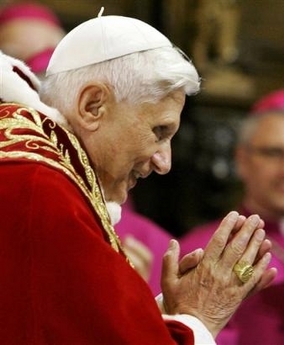
Pope Benedict XVI, aided by a young boy, left, and a young girl, releases one of two doves as a symbol of peace from his apartment window overlooking St. Peter's Square at the Vatican Sunday, Jan. 28, 2007. In his speech the pontiff called for a halt to violence in Lebanon and the Gaza strip, saying he was hugely saddened by the pain inflicted on the populations and appealing for dialogue. (AP Photo/Plinio Lepri)

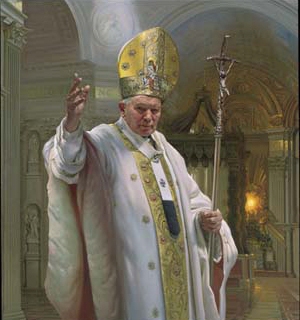
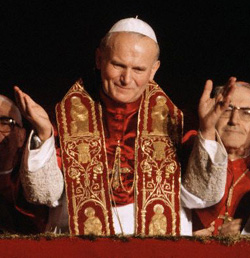
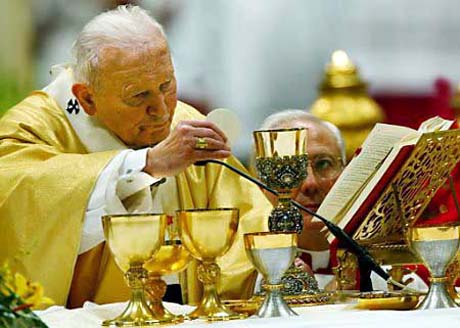
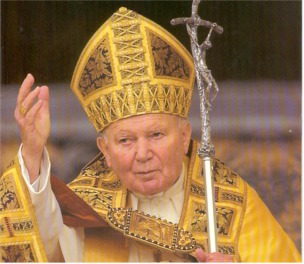
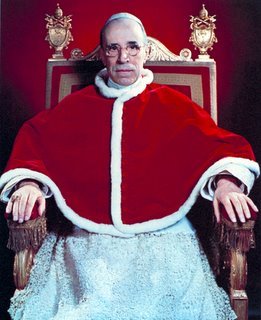
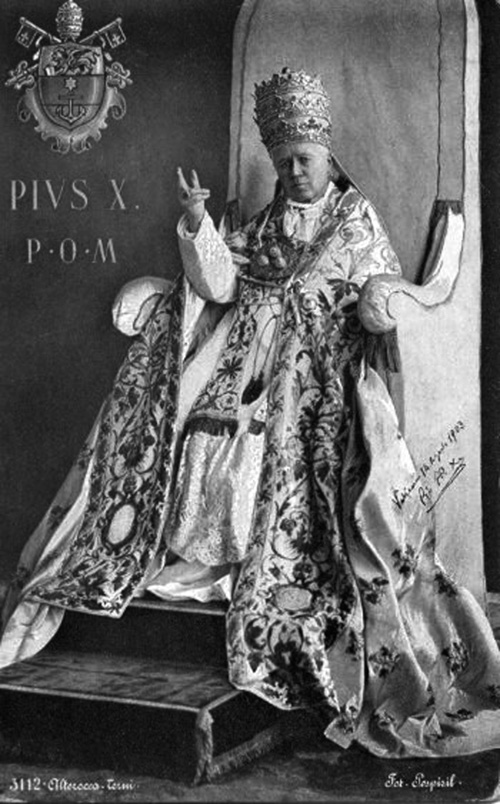
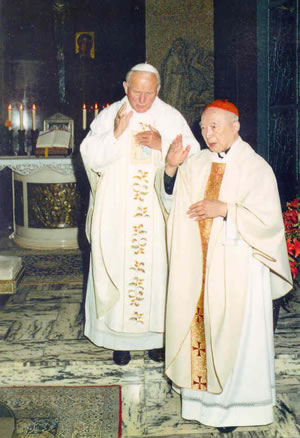
When I saw these photos, my mind harked back to the time when our beloved Pope John Paul the Great was still with us.


He had been such an inspiration to me. I'm not ashamed to tell you that I was bawling like a babe when he finally returned to the Father's House. I was up until 3AM, Malaysian time watching the latest development and praying like crazy, with the crowd in the square and the millions all over the world, praying like crazy and storming Heaven with prayer for a miracle. I fell asleep in front of the telly and when I finally woke up at about 5AM, he was already gone.

It's hard to express the sense of loss and desolation that I felt, the loss of my Father in Faith. Despite all the nonsense I put up with in my local Church, I always knew that in Rome, the Pope still reigned and the line still held.

It was a source of immense comfort for me. But then, he was gone.

Pope John Paul carried his cross, no, embraced his cross with such passion that I too was inspired to carry my own crosses with fortitude.


But the great cross of shepherding the Church of Christ on earth has been handed over. Pope Benedict XVI now bears that heavy burden. Let us pray for him in that unenviable task.

Holy Father, from your window in Heaven, look down on us and bless us who remain here fighting the good fight, running the race that you have finished.

Pray for us, Holy Father, and for me.

Pope calls for tightening up on annulment

From the Guardian:

Tom Kington in Rome
Monday January 29, 2007
The Guardian


Pope Benedict XVI has warned Vatican judges to get tough on couples who ask the Catholic Church to annul their marriages.

The Pope ordered the clampdown after new figures showed that the church's appeals court allowed 69 annulments in 2005 for reasons which included husbands being too attached to their mothers.

The court, known as the Sacra Rota, considers petitions from couples claiming their marriages were never truly valid. Apart from the get-out clause for women married to "mummy's boys", an "inability to assume conjugal obligations", usually due to a childhood trauma, appears among the successful reasons for annulment in 2005, as do alcoholism, use of cannabis, infidelity and a serious lack of "moderation in judgment" by a partner, meaning jealousy or a propensity to lie.

The Vatican does not permit divorcees to remarry in church and a growing number of annulment requests are winding their way from lower ecclesiastical courts to the appeals court in Rome, with the majority Italian, followed by requests from America and Poland. Princess Caroline of Monaco was able to annul her 1978 marriage to Philippe Junot on the grounds that they had produced no children.

But the Pope appeared to take a hard line on Saturday when he told the court's 20 judges to "respond with courage and faith" to "a distorted interpretation of the canonical norms in force".

He has repeatedly criticised the Italian government's plans for a law defining rights for unmarried couples. The institution of marriage, he said, was in danger of becoming no more than a legal agreement, "manipulated at will", and "even denied of its heterosexual character".

The Italian prime minister, Romano Prodi, said on Saturday that a bill on civil unions was close to completion.

The Catholic Church is a Cult!

Here's something very very brief I wrote this morning on the office computer in response to a friend who said that the Catholic Church is a cult and Peter was not the first Pope:

Yes, the Catholic Church is a cult, the cult of Jesus Christ.

Here’s how a cult is defined by the Webster dictionary:

Dictionary.com Unabridged (v 1.1) - Cite This Source

cult /kʌlt/ Pronunciation Key - Show Spelled Pronunciation[kuhlt] Pronunciation Key - Show IPA Pronunciation

–noun

1.

a particular system of religious worship, esp. with reference to its rites and ceremonies.

2.

an instance of great veneration of a person, ideal, or thing, esp. as manifested by a body of admirers: the physical fitness cult.

3.

the object of such devotion.

4.

a group or sect bound together by veneration of the same thing, person, ideal, etc.

5.

Sociology. a group having a sacred ideology and a set of rites centering around their sacred symbols.

6.

a religion or sect considered to be false, unorthodox, or extremist, with members often living outside of conventional society under the direction of a charismatic leader.

7.

the members of such a religion or sect.

8.

any system for treating human sickness that originated by a person usually claiming to have sole insight into the nature of disease, and that employs methods regarded as unorthodox or unscientific.

–adjective

9.

of or pertaining to a cult.

10.

of, for, or attracting a small group of devotees: a cult movie.


[Origin: 1610–20; <>cultus habitation, tilling, refinement, worship, equiv. to cul-, var. s. of colere to inhabit, till, worship + -tus suffix of v. action]


So, in instance 1,2,4 and 5, the Catholic Church is indeed the cult of Jesus Christ.

So yes, the Catholic Church is a cult, and proud of it =)


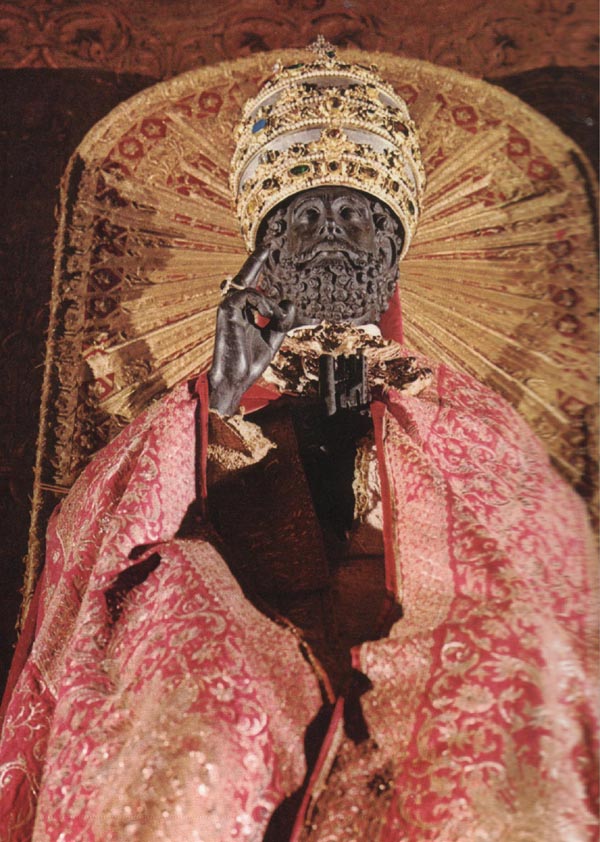
Peter is the Rock on which the Church is built.

Here’s how we deduce this fact:


Joh 1:42 Then he took Simon to Jesus. Jesus looked at him and said, "Your name is Simon son of John, but you will be called Cephas." (This is the same as Peter and means "a rock.")


In Aramaic, the language Jesus spoke, Kepha means rock. In Greek, there’s the masculine form of kepha, Petros and the feminine form, Petra. Peter is Petros in Greek because he is a man. In any instance of a name change in Scripture, God has a plan for him. When Abram’s name was change to Abraham, he was going to be the Father of a multitude. Sarai to Sarah because she was going to be mother of nations. Similarly when Jacob became Israel, his name change heralds a new destiny.


In Matt 16, we see Jesus promising to build His Church on Peter, the Rock.

He said to them, But who do you say I am?

And Simon Peter answered and said, You are the Christ, the Son of the living God.

Jesus answered and said to him, You are blessed, Simon, son of Jonah, for flesh and blood did not reveal it to you, but My Father in Heaven.

And I also say to you that you are Peter, and on this rock I will build My church, and the gates of hell shall not prevail against it.

And I will give the keys of the kingdom of Heaven to you. And whatever you may bind on earth shall occur, having been bound in Heaven, and whatever you may loose on earth shall occur, having been loosed in Heaven.


Peter, as the spokesman of the Apostles, confesses Jesus as the Christ, the Son of the Living God. Jesus in turns recognizes Simon as Son of Jonah and says that Peter spoke by a special revelation from Heaven. He then says the Peter, the Rock that on this Rock, which is clearly a play on words, He would build His Church. In Aramaic, in which Jesus was speaking, He would say “You are Kepha and on this Kepha I will build my Church”. It’s pretty clear. And it is Jesus who is the builder here, so He’s not the foundation that He is speaking of. Jesus is the real foundation, but here, He is building. He is the builder who builds on the Rock of Peter.

The most important part of this verse is the conferral of the of the keys to Peter. In the Old Testament episode, Is 22:20-23 which Jesus is alluding to, the Keys of the Kingdom of David was taken from Shebna and given to Hilkiah. Let’s look at the scripture and see what the conferral of the keys meant.

Isa 22:15 So says the Lord, Jehovah of Hosts, Go, go up to this treasurer, to Shebna who is over the house. Say

And in that day it shall be, even I will call My servant Eliakim the son of Hilkiah.

and I will clothe him with your robe, and will fasten your girdle on him, and I will give your authority into his hand. And he shall be a father to the people of Jerusalem and to the house of Judah.

And the key of the house of David I will lay on his shoulder; so he shall open, and none shall shut; and he shall shut, and none shall open.

And I will fasten him as a nail in a sure place; and he shall be for a glorious throne to his father's house.


The Keys imply authority, the authority of the King himself and the person who possessed the Keys is
Over the House, the prime minister or vicar as it were. The Holder is Father to the people of Jerusalem and the House of Judah, similarly Peter, in due time, became Father (Papa from where Pope comes from. Pope means Father) over the new Jerusalem people, the Church. Jesus, the Son of David conferred the Keys of the Kingdom of Heaven to Peter. The shutting and opening are reminiscent of the power to bind and loose which Jesus confers to Peter.

In Matt 18:18, the power to bind and loose is conferred to all the Apostles collectively, when they are in agreement, but in Peter individually in 16:18 by his sole authority without qualification.

With this in mind, even though perhaps Peter and the Eleven did not realize it yet, we can see the beginning of the primacy of Peter in the Church.

Jesus also tasks Peter with another task to strengthen his brethren after Christ prayed for him and to feed Christ’s Sheep.


Let’s look at the episode.


And the Lord said, Simon, Simon, behold, Satan has desired you(plural, meaning all the Twelve), that he may sift you as wheat. But I have prayed for you(you, singular, only Peter), that your faith fail not. And when you are converted, strengthen your brothers.

(Luk 22:31-32)


We see Jesus telling Peter that Satan wanted to tempt all of them but Jesus was praying for Peter alone. Peter is then tasked to strengthen his brothers, the Eleven.

Here’s another episode.

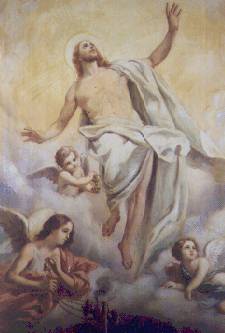
Then when they broke fast, Jesus said to Simon Peter, Simon, son of Jonah, do you love Me more than these? He said to Him, Yes, Lord, You know that I love You. He said to him, Feed My lambs. He said to him the second time, Simon, son of Jonah, do you love Me? He said to Him, Yes, Lord, You know that I love You. He said to him, Feed My sheep. He said to him the third time, Simon, son of Jonah, do you love Me? Peter was grieved because He said to him a third time, Do you love Me? And he said to Him, Lord, You know all things, You know that I love You. Jesus said to him, Feed My sheep. Truly, truly, I say to you, When you were young, you girded yourself and walked where you wished. But when you grow old, you shall stretch forth your hands and another shall gird you and carry you where you do not wish. He spoke this signifying by what death he should glorify God. And when He had spoken this, He said to him, Follow Me.
(Joh 21:13-19)

Peter’s triple affirmation atoned for his triple denial. And Peter is tasked by Jesus to feed his lambs and His sheep.

The Apostles had successors who carried on their task of evangelization. In Acts, we read of this episode:

And in those days Peter stood up in the midst of the disciples and said, (the number of names together was about a hundred and twenty,) Men, brothers, this Scripture must have been fulfilled, which the Holy Spirit by the mouth of David spoke before concerning Judas, who became guide to those who seized Jesus. For he was numbered with us and had obtained part of this ministry. Indeed, then, this one purchased a field with the reward of unrighteousness. And falling headlong, he burst apart in the middle, and all his bowels gushed out. And it was known to all the dwellers at Jerusalem, so much so that that field is called in their own dialect, Akeldama, that is to say, Field of Blood. For it is written in the Book of Psalms, "Let his estate become forsaken, and he not be living in it." And, "Let another take his overseership." Therefore, it is right that one of these men who have companied with us all the time that the Lord Jesus came in and went out among us, beginning from the baptism of John to that same day that He was taken up from us, to become a witness with us of His resurrection. And they appointed two, Joseph called Barsabas, who was surnamed Justus, and Matthias. And they prayed and said, You, Lord, knower of all hearts, show which one You chose from these two, to take the share of this ministry and apostleship from which Judas fell, to go to his own place. And they gave forth their lots. And the lot fell upon Matthias. And he was numbered with the eleven apostles.

(Act 1:15-26)

Judas place as one of the Twelve was replaced by Matthias, who was then numbered among the Eleven. So this Apostolic tradition was carried on and the bishops today are successors of the Apostles by the laying on of hands. Peter in his turn was succeeded by Linus after his own death.

In short, this is what the Pope, the Father of the People of the New Jerusalem, the Christian Church on Earth is and does.

He holds the Keys of the Kingdom and is over the house when the Master is away, therefore he is Vicar of Christ on Earth.

Individually, he has the power to bind and loose and Jesus promised to bind and loose in Heaven what Peter has bound and loosed on earth. Therefore, Peter, when binding and loosing something on the whole Church must be protected from error, or else Jesus, by virtue of His promise would have to bind and loose error in Heaven. This is the infallibility of the Pope. The college of Apostles, whom the bishops are now the successors of, have the same power collectively.

Peter is also asked to strengthen his brothers. That’s what the Pope does, strengthens and corrects when the need arises.

Peter is also tasked with feeding all of Christ’s Sheep and Lambs, so he is Pastor (which means Shepherd) of the Universal Church.

That’s it. The Papacy in Scripture.

Friday, January 26, 2007

Unto us a child is born!

Madeleine Jane Doyle was born at 2341hrs on Thursday, January 25th 2007 weighing in at 6lb 15oz!!!

Matt Doyle, over at Lacrimarum-Valle, is now a proud father.

Please do continue to pray for Matt and Wendy and for little baby Madeleine whom the entire blogosphere seems to have adopted as their own =)


Weighing in at 3.16kg (6lb 15oz)!!

May the Good Lord bless them all and give them the grace to walk in His ways and sustain them all the days of their life.

Wednesday, January 24, 2007

Pray for the Doyle Family

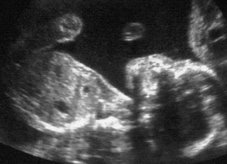
I just want to ask all of you dear readers to pray for Matt and Wendy Doyle as they wait for the birth of their first child Maddy.


Madeleine Doyle
Madeleine Doyle
at 20 weeks gestation

You can use the Litany that Joee has so generously provided here. The Franciscan Brother Francesco(pictured on the left) is attempting to persuade His Holiness to attach a plenary indulgence to it!

Do pray for this young and faithful Catholic couple as they embark on this new and wonderful phase in their life that God may shower His blessings on them and guide them with His mighty hand.

Father Tim at the Hermeneutic of Continuity has proposed a wonderful spiritual bouquet, similar to the one we had last week for my parish priest Fr. Marshall who had a minor heart attack. Brilliant idea Fr. Tim. Do add your prayers here.

I've raised the Doyle's in prayer when I led the novena to the Divine Mercy last Friday. When I lead the novena to Our Lady of Perpetual Succour this Saturday, this intention will be first on the list again. I've also txt'd our Charismatic prayer group who are asking all their 'prayer warriors' to storm Heaven for the Doyle's as well. From Joee, you can track the prayers being offered all over the world.

God hears the fervent prayers of His children, so pray away!

Personally, I'm just itching to sing a Te Deum as soon as I hear the good news. =)

I'll update you guys as soon as I have more. In the meantime, do check out Matt's excellent blog, Lacrimarum-Valle.

Monday, January 22, 2007

UCAN: Major archbishop's sudden death saddens Syro-Malankara Church

The Catholic Church does not only consist of us who follow the Roman Rite. Many other sui juris Churches form part of the Catholic Church as well.

Let us pray for our brothers and sisters in the Syro-Malankara Church who have just lost their Father and Shepherd. Looking at the turnout, and reading the heartfelt sentiments expressed by the simple folk and dignitaries alike, one can easily see how beloved the late Major Archbishop was.

I thought is was really fascinating, the way the Major Archbishop was carried around almost upright throughout the ceremonies.

And the vestments were glorious.


From Catholic.org
Photos courtesy of the Church's official website at Malankara.net.

UCAN: Major archbishop's sudden death saddens Syro-Malankara Church

1/19/2007

UCANews (www.ucanews.com)


PATTOM, India (UCAN) – The Catholic Church's youngest Oriental rite plunged into sadness after its head, Major Archbishop Cyril Baselios, died unexpectedly on Jan. 18

The 72-year-old major archbishop was hospitalized the previous day following kidney-related complications, according to his secretary, Father Varghese Kalayil. He suffered a heart attack at 6:45 p.m. while taking a stroll in the hospital corridors and died immediately, the priest told UCA News.

His church is based in Kerala state, southern India, and the major archbishop stayed in Pattom, a suburb of the state capital, Thiruvananthapuram, 2,815 kilometers (1,745 miles) south of New Delhi.


Major Archbishop Baselios was president of the Catholic Bishops' Conference of India 2000-2004. The conference includes all bishops from India's three rites – Latin, Syro-Malankara and Syro-Malabar – which make up the Catholic Church in India. The Latin rite follows the Roman liturgy and was established by European missioners in the 15th century, while the two Oriental rites, both based in Kerala, follow Syrian church traditions and trace their origins to St. Thomas the Apostle.

As television channels in Kerala flashed the news soon after the prelate's death, people began flocking to the church's headquarters. As the crowd swelled, the administration deployed police to manage the mourners.

"We have lost our father," said Edizon Joseph, a Syro-Malankara Catholic from Kerala, 225 kilometers (about 140 miles) to the north. Major Archbishop Baselios "was always a source of inspiration to all of us," the 44-year-old man continued. "We could knock on his door at any time."

Joseph Thomas from Ullannur, the prelate's native village, rushed to the capital city upon hearing the news. He recalled that the church leader had helped him complete studies and always guided him. "I came here to express my gratitude," Thomas, an engineer, told UCA News.

Hundreds of nuns, priests and laypeople spent the night in prayer. To accommodate the crowds, the prelate's body was moved from the bishop's house to nearby St. Mary's Cathedral, where funeral services are scheduled to take place on Jan. 20.


Church leaders joined political leaders in condoling the death.

Catholicos Baselios Thomas I, head of the Jacobite Syrian Orthodox Church in India, in his message, described the late prelate as "a great friend of the Syrian Jacobite Church in Kerala and a pillar of inspiration." The Syro-Malankara rite was part of the Jacobite church before coming into the Catholic fold in 1930.

The head of the Latin-rite church in Kerala, Archbishop Daniel Acharuparambil of Verapoly, hailed the major archbishop as a "charismatic leader who helped the Malankara Church achieve fast growth spiritually and socially," and who stood in the forefront when the Catholic Church faced challenges.

Cardinal Varkey Vithayathil of Ernakulam-Angamaly, major archbishop of the Syro-Malabar Church, stated in his condolence message that the Indian church has lost a "true leader" who "led the church with his vision and mission during the times of crises." He always tried to uphold human rights and human values, and dedicated his life for the poor and the marginalized, the cardinal noted. The Syro-Malabar Church leader recalled that the late prelate helped fight for the rights of minorities "whenever their freedom was challenged."

Archbishop Oswald Gracias of Bombay, head of the Indian Latin-rite bishops' conference, said the late prelate was committed to inculturation of the church. The major archbishop was "an efficient facilitator" between India's Oriental rites and the universal church, he added.

Kerala Chief Minister V.S. Achuthanandan described the late prelate's contributions to the state as unparalleled. He "worked for communal harmony and development of society," the communist leader told UCA News.


Others who condoled the death were federal Defense Minister A.K. Antony and Oommen Chandy, Kerala's opposition leader.

The Syro-Malankara rite was made a major archiepiscopal church in February 2005, with the late prelate became its first major archbishop. The church has 500,000 Catholics in two archdioceses and four dioceses.

'Bishop, I Have the Pope on Line One'

From the American Spectator.

I just love the title =)

'Bishop, I Have the Pope on Line One'
By Thomas J. Craughwell
Published 1/17/2007 12:07:27 AM

The other week Pope Benedict XVI phoned a few French bishops, and it wasn't to find out what they got for Christmas. According to Britain's Catholic Herald, the pope was doing a bit of old-fashioned arm-twisting in response to these bishops' very public opposition to Benedict's intention to grant Catholics more access to the pre-Vatican II rite of the Mass.

On October 30, 2006, ten French bishops, including the archbishop of Strasbourg, released a letter expressing their fear that "the extension of the use of the Roman Missal of 1962 makes the direction of the Second Vatican Council relative... [and] would also risk harming unity among priests as well as among the faithful." One of the signers of the statement, Bishop Andre Lacrampe of Besancon, has been quoted as saying, "One cannot erase Vatican II with a stroke of the pen."

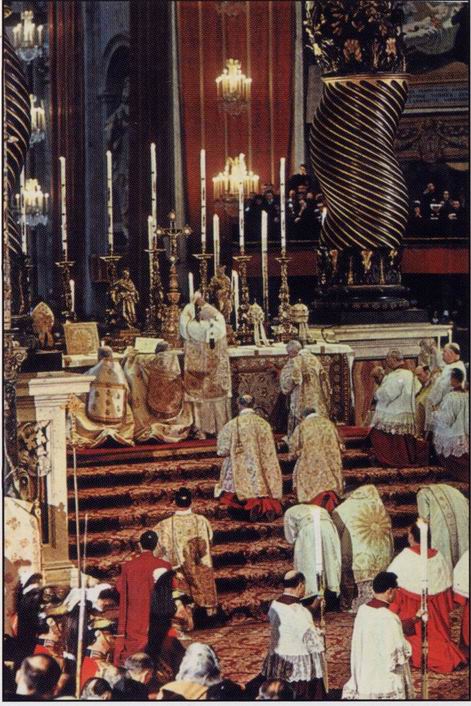
Is Pope Benedict about to abolish Vatican II? Not quite. What he is doing, in fact, is implementing one of the council's guarantees, spelled out in its document on the Mass, Sacrosanctum Consilium, "In faithful obedience to tradition, the sacred Council declares that holy Mother Church holds all lawfully acknowledged rites to be of equal right and dignity; that she wishes to preserve them in the future and to foster them in every way." Of course, it didn't pan out that way. In 1969 Pope Paul VI virtually banned the traditional Mass and imposed on the Church the Novus Ordo Missae, the New Order of the Mass that has been the norm in Catholic parishes around the globe ever since.

Paul VI's Mass was no simple vernacular translation of the traditional text; this was a major edit-and-rewrite job that recast the role of the priest, the people, and even God's place in the liturgical life of the Catholic Church. It was, in short, a revolution. And as Robespierre could tell you, once a revolution gets rolling, it's hard to tell exactly where it will end up.

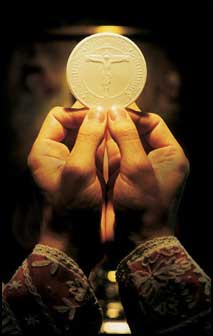
Once the new Mass was put in place, the progressives went on a rampage the likes of which the Church had not seen since the Reformation. On Sunday mornings, while the parish clergy hung out in the rectory, members of the laity distributed Communion to congregations who were instructed to stand, not kneel, to receive the Body and Blood of Christ, and urged to take the Sacred Host, the consecrated bread, in their hands rather than receive it on their tongue. Then came the church "wreckovations" -- altars were smashed, communion rails ripped out, statues hauled away to the dumpster or banished to obscure corners of the church, and elaborately decorated interiors whitewashed. The documents of Vatican II did not call for any of these soul-and-gut wrenching innovations, but when confronted the progressives claimed that their actions were in keeping with "the spirit of Vatican II."
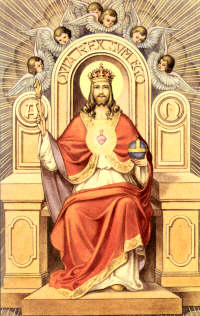
The-not-too-subtle message of this revolution was, if the Mass, the thing the Church held most sacred, could be monkeyed with, then it was open season on doctrine, discipline, religious authority, religious vows, church music, education, sexuality, marriage, and life itself. As the Catholic Church sank into chaos, many Catholics jumped ship. A 1958 Gallup poll found that in the United States 75 percent of Catholics went to Mass every Sunday; today the number has dropped to 25 percent. By the way, on any given Sunday in France, the bishops can count on seeing about five percent of the population.


MASS ATTENDANCE WAS NOT the only thing that suffered in the upheavals that followed Vatican II. Today 53 percent of American Catholics believe that one can have an abortion and still be a good Catholic. And 70 percent of American Catholics in the 18-44 age group say they do not believe that the Eucharist is truly the Body and Blood of Christ, that it is only a symbol of Jesus.

As for religious vocations, the statistics are dire. In 1965, 1,575 new priests were ordained in the United States; in 2002 there were 450 ordinations. In 1965 there were 600 seminaries in the United States; today there are about 200. In 1965 there 180,000 nuns in the United States, 104,000 of whom were teaching sisters; in 2002 there were 75,000 sisters, only 8,200 of whom were in the classroom. As for the famous Christian Brothers who staffed so many Catholic schools, in 1965 there were 912 young men preparing to take their vows; in 2000 there were only seven. (All these numbers come from Kenneth Jones' Index of Leading Catholic Indicators).

In the aftermath of Vatican II, the Catholic Church has split into roughly two camps. First, there are the liberals/progressives, bishops, clergy, and laity who see Vatican II as a complete break with the Church's past, its doctrines as well as its traditions. On the other side are the conservatives/traditionalists, those bishops, priests, and laity who insist that Vatican II must be read in light of the Church's doctrine and traditions. Until now the progressives have had the conservatives on the run. But since his election, Benedict XVI has said openly that Vatican II is just one in a long series of church councils, and to argue that it swept away everything that came before it is to mangle the council documents beyond recognition.

Naturally the two factions have aligned themselves with two opposing schools of theology. The conservatives defend the Church's traditional God-centered view of the universe. Nothing conveys their perspective better than the traditional Mass in which the priest, the altar boys, and the people all face the altar, with the tabernacle that contains the Host and the crucifix above the altar as the focal points of their prayers. This God-centered perspective also dominates the conservative ideas about themselves and how they interact with their neighbors. It can be summed up in a basic question, "How is one saved?" And the basic answer is, "By keeping God's commandments."


THE THEOLOGY OF THE PROGRESSIVES is decidedly man-centered (oops! make that person-centered). Again, it starts with the Mass, where the priest stands at a table facing the congregation (by the way, the Vatican Council didn't call for that either). The focus then has become the interplay between the priest and the people, and in all too many instances priests have found it hard to resist the temptation to be an entertainer, urged on by his congregation's appreciative laughs and rounds of applause that are common these days in forward-thinking parishes. God is an afterthought in such places. The tabernacle is off in a side room, usually out of sight, and the crucifix is portable, carried in at the start of Mass and carried out when it is over -- and for good reasons: the presence of the Real Presence, the image of Christ dying on the cross make the "worship space" too churchy, which could put a damper on the folksy "I'm okay-you're okay-God's okay" spirit of the congregation. In terms of theology the progressives tend to be utilitarian: the issues of a celibate clergy, same-sex marriage, abortion, and euthanasia are difficult and make many people uncomfortable, so the easiest solution to such thorny issues is to sanction them all.

Then in 1988 Pope John Paul II threw the conservatives a lifeline, granting permission (the ecclesiastical term is indult) for priests to say the traditional Latin rite of the Mass. In a document entitled Ecclesia Dei (The Church of God), the pope declared, "Respect must everywhere by shown for the feelings of all those who are attached to the Latin liturgical tradition by a wide and generous application of the directives already issued some time ago by the Apostolic See for the use of the Roman Missal according to the typical edition of 1962." But there was a hitch: priests who wished to say the old Mass, and Catholics who wished to attend it, had to apply to their local bishop for permission. In response to such requests, few bishops could be described as "generous."

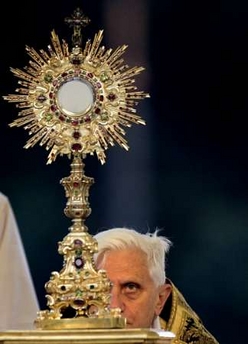
Conservatives cheered when Cardinal Ratzinger became Pope Benedict XVI because he had written and preached in support of the old Mass and often celebrated it publicly himself. Ever since the election conservatives and liberals have been waiting to see what Benedict will do. Now he is ready to act.

Unlike the implementation of Paul VI's Mass in 1969, Benedict XVI's decision to take the handcuffs off the old Mass is not a revolution but a challenge. He is not going to abolish the new Mass. Instead he is setting up the traditional Mass with its traditional theology as an alternative to what is available in the typical Catholic parish.

At this writing the document has not been released, and no one at the Vatican who has read it has leaked its full contents. One thing is certain, however: With this document the pope is undermining the monopoly the progressives have had on parish life. For the first time in a long time Catholics who have clung to the traditional teachings of the Church and cherished the traditional liturgy will have a place they can call home.


Thomas J. Craughwell is an author and commentator on Catholic issues. He lives in Bethel, Connecticut.