Tuesday, May 20, 2008

Pope to the Young

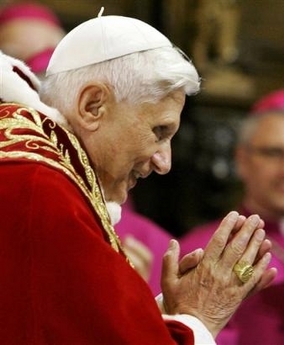
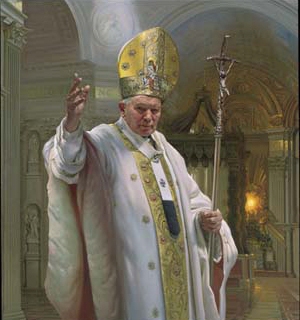
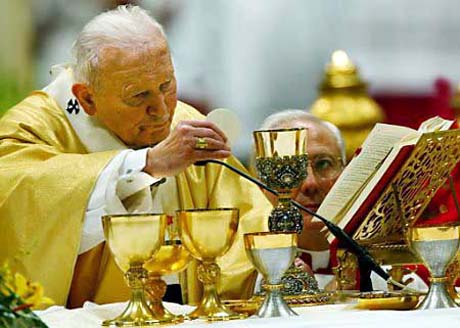
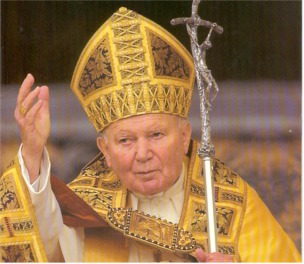
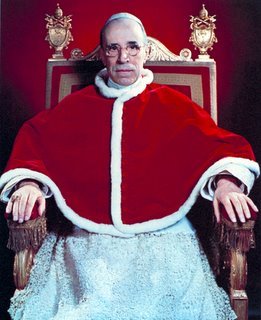
I thought that these images of the Pope were wonderful. The Holy Father now seems very happy and comfortable in his role, very content, a sure sign of someone who has wholly put everything in the hands of God.

From the Vatican Information Service.

YOUNG PEOPLE: CULTIVATE SPIRITUAL LIFE AND FORMATION

VATICAN CITY, 18 MAY 2008 (VIS) - Following his visit to Genoa's "Giannina Gaslini" paediatric hospital this morning, the Pope met with a group of young people in the city's Piazza Matteotti.


"You are the youth of Genoa!" he exclaimed in opening his address. "Youth", he told his audience, "real youth, is not a question of years and physical vigour. ... There are, unfortunately, people young in years but old within. ... Being young means having discovered the things that do not pass with the swift passage of the years. If young people discover the real and great values, they never grow old, despite the fact that the body follows its own laws".

"Only people who are good and generous are truly young", he said. "I hope you will remain young; not fashionable, for fashions disappear in the winking of an eye, hurtling by in a frenetic career. Youth, on the other hand, the youth of goodness, remains forever. Indeed, it will be perfect and resplendent in heaven with God".

"Youth still has all its future ahead. ... The future is full of promise. Today however, for many, it is also full of threats, especially the threat of a great void. Hence many people want to hold back time for fear of a future in emptiness". Faced with such a situation, "it is important to choose real promises that open to the future, even by making sacrifices. ... And the first fundamental choice must be God".

The Holy Father invited the young people "to cultivate spiritual life. ... The life of the soul", he explained, "is meeting with Him, the real Face of God, it is silent and persistent prayer, it is sacramental life, it is meditating upon the Gospel, it is spiritual accompaniment, it is cordial membership of the Church and of your ecclesial communities.

"Yet how", he added, "can one love what one does not know? ... Hence the need to delve more deeply into the mystery of Jesus, the truth of His thought that resounds in the Gospel and in the Church's Magisterium. Without a solid formation", he went on, "how will it be possible to explain the faith to your peers, so full of questions about life, about themselves, about Christian faith, and the Church?"

The Holy Father encouraged the young people to announce the Gospel "in the various areas of life, in your parishes, in the most difficult neighbourhoods, in the streets. Announce Christ the Lord, hope of the world. The more man distances himself from God (Who is his Source) the more he loses himself; human coexistence becomes difficult and society crumbles. Remain united to one another, help one another to live and grow in faith and Christian life, in order to become intrepid witness of the Lord".

"If you remain united to Christ and the Church, you can achieve great things. This is the hope I consign to you" he concluded. "Goodbye until we meet again in Sydney!"

Saturday, May 17, 2008

St. Felix of Cantalice


Some of you might be saying 'Who?', but St. Felix of Cantalice was the first canonized saint of the Capuchin branch of the Franciscan order, a contemporary of St. Phillip Neri and St. Charles Borromeo. Interesting, eh? Bet you didn't know that.

Let's find out more about this great saint.

A Capuchin friar, born at Cantalice, on the north-western border of the Abruzzi, he is usually represented in art as holding in his arms the Infant Jesus, because of a vision he once had, when the Blessed Virgin appeared to him and placed the Divine Child in his arms.

A friend of his having read to him the lives ot the Fathers of the Desert, Felix conceived a great desire for the eremitical life, but at the same time feared to live otherwise than under the obedience of a superior. After seeking light in prayer, he determined to ask admittance amongst the Capuchins. At first the friars hesitated to accept him, but he eventually received the habit, in 1543, at Anticoli in the Roman Province. It was not without the severest temptations that he persevered and made his profession. These temptations were so severe as injure his bodily health. In 1547 he was sent to Rome and appointed questor (which is a nice word for beggar) for the community. Here he remained for the rest of his life, and in fulfilling his lowly office became a veritable apostle of Rome.

The influence which he speedily gained with the Roman people is an evidence of the inherent power of personal holiness over the consciences of men. He had no learning he could not even read; yet learned theologians came to consult him upon the.science of the spiritual life and the Scriptures. Whenever he appeared in the streets of Rome vicious persons grew abased and withdrew from his sight. Sometimes Felix would stop them and earnestly exhort them to live a better life; especially did he endeavour to restrain young men. But judges and dignitaries also at times incurred his rebuke, he was no respecter of persons when it was a matter of preventing sin. On one occasion, during a Carnival, he and St. Philip Neri organized a procession with their crucifix; then came the Capuchin friars; last came Felix leading Fra Lupo, a well-known Capuchin preacher, by a rope round his neck, to represent Our Lord led to judgment by his executioners. Arrived in the middle of the revels, the procession halted and Fra Lupo preached to the people. The Carnival, with its open vice, was broken up for that year.

But Felix's special apostolate was amongst the children of the city, with whom his childlike simplicity made him a special favourite. His method with these was to gather them together in bands and, forming circle, set them to sing canticles of his own composing, by which he taught them the beauty of a good life and the ugliness of sin. These canticles became popular and frequently, when on his rounds in quest of alms, Felix would be invited into the houses of his benefactors and asked to sing. He would seize the opportunity to bring home some spiritual truth in extemporized verse. During the famine of 1580 the directors of the city's charities asked his superiors to place Felix at their disposal to collect alms for the starving, and he was untiring in his quest.

St. Philip Neri had a deep affection for the Capuchin lay brother, whom he once proclaimed the greatest saint then living in the Church. When St. Charles Borromeo sought St. Philip's aid in drawing up the constitutions of his Oblates, St. Philip took him to St. Felix as the most competent adviser in such matters. But through all, Felix kept his wonderful humility and simplicity. He was accustomed to style himself "Ass of the Capuchins". Acclaimed a Saint by the people of Rome, immediately after his death, he was beatified by Urban VIII in 1625, and canonized by Clement Xl in 1712. His body rests under an altar dedicated to him in the church of the Immaculate Conception to Rome.

When he died on 18 May 1587 at Rome; so many came to his funeral that some were injured in the press to get into the church, and an extra door had to be knocked through one wall so they could exit; buried under an altar in the church of the Immaculate Conception in Rome.

We have a friary in Penang, housing a group of Capuchins. The patron of the friary is St. Felix of Cantalice and his Feast Day was celebrated with appropriate solemnity there. Come back tomorrow for a report.

Bring Flowers of the Rarest

Because this is the month of May, the month of Our Lady. Throughout the month of May, the Holy Rosary is prayed before each Mass. The Confirmation class I teach had their session earlier on (but I forgot to take photos). The servers did it last Sunday, led by Mark. It was nice having the cassocked servers lead the people in the rosary. The attendance for the rosary for the weekend Masses is very good.

DSC00737

DSC00738

On the 13th of every month, we normally have a rosary and Mass at the outdoor shrine of Our Lady.
DSC06131

DSC06134

This month, the rosary and Mass was held in the Church.

DSC08342

On that day, during the the evening weekday Mass, IC parish also celebrated and honoured all our healthcare workers and all the doctors and nurses who attended the Mass were called up to take a pledge to defend the sanctity of life and to perform their duties to the best of their abilities.

DSC08345

The parish of the Immaculate Conception includes within its bounds 7 major hospitals including the Penang General Hospital which is the 2nd largest hospital in Malaysia. The hospital visits keeps the parish priest very busy so the ministry of Extraordinary Ministers of Holy Communion is an important and very necessary one in this parish to visit the sick and the homebound and to give them Holy Communion.

DSC08346

Fr. Marshall then blessed them with Holy Water.

DSC08347

Grandma took a moment to pray at the Shrine of Our Lady of Fatima after the Mass.

DSC08333

Wednesday, May 14, 2008

Swearing in of the Swiss Guards


Pope: Swiss Guards' Uniforms Speak of Commitment


Thanks Corps for "Serving the Servant of God's Servants"


From Zenit.

VATICAN CITY, MAY 5, 2008 (Zenit.org).- Benedict XVI is praising the Swiss Guard for their commitment to serving God by serving Christ's Vicar.

The Pope spoke to 33 new recruits of the guard today, accompanied by their families and other members of the corps. The new recruits will be sworn in Tuesday.

May 6 is the traditional swearing-in day for new recruits of the Pontifical Swiss Guard because on that day in 1527, some 150 members of the Swiss Guard lost their lives during the sack of Rome, protecting Pope Clement VII and the Church from the onslaught of Emperor Charles V's troops.

In the Holy Father's address, delivered in German, French and Italian, he pointed out how, five centuries after the foundation of the corps, "the spirit of faith that encourages young Swiss to leave their beautiful land to come and serve the Pope in the Vatican remains unchanged."
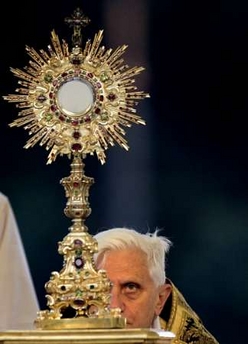
"The love for the Catholic Church remains the same, to which you bear witness, rather than with words, with your bodies, which -- thanks to the characteristic uniforms -- are easily recognizable at the entrance to the Vatican and to pontifical audiences," he added. "Your historic uniforms speak [...] of your commitment to serve God by serving the 'servant of his servants.'"

Ecclesial spirit

Benedict XVI called on the new recruits "above all to assimilate this Christian and ecclesial spirit, which is the foundation and the motor of all the activities you will undertake."

"Always cultivate prayer and spiritual life, also by taking advantage of the crucial presence of your chaplain," he encouraged them. "Be open, straightforward and loyal. Learn how to appreciate the differences of personality and character that exist among you, because under the uniform each one is a unique and irreplaceable person called by God to serve his Kingdom of love and peace."


The Swiss Guard, the Pope affirmed, "is also a school of life," and he noted how during their period of service in the Vatican "many of your predecessors were able to discover their own vocation: to Christian marriage, to the priesthood, to consecrated life. This is a reason to praise God, but also to appreciate your corps."


The Holy Father concluded by thanking all members of the Pontifical Swiss Guard for the "generosity and dedication with which you work in the service of the Pope. May the Lord reward you and fill you with abundant heavenly fruits."

Profiles

The 33 new recruits will be sworn in as members of the Pontifical Swiss Guards in the presence of members of the Roman Curia, diplomatic representatives and civil and religious authorities from Switzerland. Twenty will take their oath in German, 11 in French, one in Italian and one in Romansch.

The Pontifical Swiss Guard was founded by Pope Julius II in 1506 as a stable corps, directly dependant on the Holy See. Its main duties were to guard the person of the Roman Pontiff and the Apostolic Palaces.

To become a guard, one must be a Swiss Catholic male under the age of 30, unmarried, over 174 cm (5' 8") in height and with a professional diploma or high school degree. The candidate must have attended Swiss military school. Guards live inside Vatican City. The minimum term of service is 25 months.


Tuesday, May 13, 2008

Just thought you'd like to see what liturgical life in the Bahamas is like.
Archbishop of Nassau Patrick Pinder conducts the funeral for nine Haitian migrants at the Loyola Hall community center, in Nassau, Wednesday, April 30, 2008. Few relatives and hundreds of Haitian residents in the Bahamas attended the ceremony after fourteen Haitian migrants, trying to escape their impoverished homeland, perished when their boat went down off the Bahamas coast last Sunday, April 20. (AP Photo/Tim Aylen)