Tuesday, November 14, 2006

LANGUAGE IN THE ROMAN RITE LITURGY: LATIN AND VERNACULAR

LANGUAGE IN THE ROMAN RITE LITURGY: LATIN AND VERNACULAR

Keynote Address
Gateway Liturgical Conference
St Louis, Missouri
November 11, 2006

by Francis Cardinal Arinze, Prefect for the Congregation of Divine Worship

1. Excelling Dignity of Liturgical Prayer

The Church which was founded by our Lord and Savior Jesus Christ strives to bring together men and women from every race, language, people and nation (cf Rev 5:9), so that "every tongue should acknowledge Jesus Christ as Lord to the glory of God the Father" (Phil 2:11). On Pentecost day there were men and women "from every nation under heaven" (cf Acts 2:5) listening as the Apostles recounted the wonderful works of God.

This Church, this new people of God, this Mystical Body of Christ, prays. Her public prayer is the voice of Christ and his Bride the Church, Head and members. The liturgy is an exercise of the priestly office of Jesus Christ. In it, full public worship is performed by the whole Church, that is, by Christ who associates with him his members. "From this it follows that every liturgical celebration, because it is an action of Christ the priest and of his Body the Church, is a sacred action surpassing all others. No other action of the Church can match its claim to efficacy, nor equal its degree of it" (Sacrosanctum Concilium, 7). From the sacred spring of the liturgy, all of us who thirst for the graces of the redemption draw living water (cf Jn 4:10).

Consciousness that Jesus Christ is the high priest in every liturgical act should instill in us great reverence. As St Augustine says, "He prays for us, he prays in us, and he is prayed to by us. He prays for us as our priest; he prays in us as our head; and he is prayed to by us as our God. Let us therefore recognize our voices in him and his voices in us" (Enarratio in Psalmum, 85: CCL 39, 1176).

2. Different Rites in the Church

In the sacred liturgy the Church celebrates the mysteries of Christ by means of signs, symbols, gestures, movements, material elements and words. In this reflection we are focusing on words used in divine worship in the Roman or Latin Rite. The core elements of the sacred liturgy, the seven sacraments, come from our Lord Jesus Christ himself. As the Church spread and grew among various peoples and cultures, various ways of celebrating the mysteries of Christ also developed. Four parent rites can be identified as the Antiochene, Alexandrine, Roman and Gallican. They gave rise to nine major rites in the Catholic Church today: in the Latin Church the Roman Rite is predominant and then among the Eastern Churches we find the Byzantine, Armenian, Chaldean, Coptic, Ethiopian, Malabar, Maronite and Syrian Rites. Each "Rite" is an historic blending of liturgy, theology, spirituality and Canon Law. The fundamental characteristics of each undoubtedly go back to the earliest centuries, the essentials to the apostolic age if not to Our Lord Himself.

The Roman Rite, which is the subject of our reflection, is in modern times, as we have said, the predominant liturgical expression of the ecclesial culture we call the Latin Rite. You will know that in and around the Archdiocese of Milan a "sister Rite" is in use that takes its name from Saint Ambrose, the great Bishop of Milan: the "Ambrosian Rite". In certain locations and on special occasions the liturgy is celebrated in Spain according to the ancient Hispanic or Mozarabic Rite. These two venerable exceptions do not concern us here.

The Church in Rome used Greek from the beginning. Only gradually was Latin introduced until the fourth century when the Church in Rome was definitely latinized (cf A.G. Martimort: The Dialogue between God and his people, in A.G. Martimort ed.: The Church at Prayer, Collegeville, 1992, I, p. 161-165).

The Roman Rite has spread in most of what was known as Western Europe and the continents evangelized largely by European missionaries in Asia, Africa, America and Oceania. Today, with an easier movement of peoples, there are Catholics of the other rites (roughly identified as the Oriental Churches) in all these continents.

Most rites have an original language which also gives each rite its historical identity. The Roman Rite has Latin as its official language. The typical editions of its liturgical books are to this day issued in Latin.

It is a remarkable phenomenon that many religions of the world, or major branches of them, hold on to a language as dear to them. We cannot think of the Jewish religion without Hebrew. Islam holds Arabic as sacred to the Qur'an. Classical Hinduism considers Sanskrit its official language. Buddhism has its sacred texts in Pali.

It would be superficial to dismiss this tendency as esoteric, or strange, or outmoded, old or medieval. That would be to ignore a fine element of human psychology. In religious matters, people tend to hold on to what they received from the beginning, how their earliest predecessors articulated their religion and prayed. Words and formulae used by earlier generations are dear to those who today inherit from them. While a religion is of course not identified with a language, how it understands itself can have an affective link with a particular linguistic expression in its classical period of growth.

3. Advantages of Latin in the Roman Liturgy

As was mentioned above, by the fourth century, Latin had replaced Greek as the official language of the Church of Rome. Prominent among the Latin Fathers of Church who wrote extensively and beautifully in Latin were St Ambrose (339-397), St Augustine of Hypo (354-430), St Leo the Great (+ 461) and Pope Gregory the Great (540-604). Pope Gregory, in particular, brought Latin to a great height in the sacred liturgy, in his sermons and in general Church use.

The Roman Rite Church showed extraordinary missionary dynamism. This explains why a greater part of the world has been evangelized by heralds of the Latin Rite. Many European languages which we regard as modem today have roots in Latin, some more than others. Examples are Italian, Spanish, Romanian, Portuguese and French. But even English and German do borrow from Latin.

The Popes and the Roman Church have found Latin very suitable for many reasons. It fits a Church which is universal, a Church in which all peoples, languages and cultures should feel at home and no one is regarded as a stranger. Moreover, the Latin language has a certain stability which daily spoken languages where words change often in shades of meaning cannot have. An example is the translation of the Latin "propagare". The Congregation for the Evangelization of Peoples when it was founded in 1627 was called "Sacra Congregatio de Propaganda Fide". But at the time of the Second Vatican Council many modern languages use the word "propaganda" in the sense in which we say "political propaganda". Therefore there is a preference in the Church today to avoid the expression "de propaganda Fide", in favor of "the Evangelization of Peoples". Latin has the characteristic of words and expressions retaining their meaning generation after generation. This is an advantage when it comes to the articulation of our Catholic faith and the preparation of papal and other Church documents. Even the modern universities appreciate this point and have some of their solemn titles in Latin.

Blessed Pope John XXIII- in his Apostolic Constitution, Veterum Sapientia, issued on February 22, 1962, gives these two reasons and adds a third. The Latin language has a nobility and dignity which are not negligible (cf Veterum Sapientia, 5, 6, 7). We can add that Latin is concise, precise and poetically measured.

Is it not admirable that people, especially well trained clerics, can meet in international gatherings and be able to communicate at least in Latin? More importantly, is it a small matter that one million young people could meet in the World Youth Day Convention in Rome in 2000, in Toronto in 2002 and in Cologne in 2005, and be able to sing parts of the Mass, and especially the Credo, in Latin? Theologians can study the original writings of the early Latin Fathers and of the Scholastics without tears because these were written in Latin.

It is true that there is a tendency, both in the Church and in the world at large, to give more attention today to modern languages, like English, French and Spanish, which can help one secure a job quicker in the modern employment market or in the Ministry of Foreign Affairs in their country. But the exhortation of Pope Benedict XVI to the students of the Faculty of Christian and Classical Letters of the Pontifical Salesian University of Rome, at the end of the Wednesday General Audience of February 22, 2006, retains its validity and relevance. And he pronounced it in Latin! Here is my free English translation: "Quite rightly our predecessors have urged the study of the great Latin language so that one may learn better the saving doctrine that is found in ecclesiastical and humanistic disciplines. In the same way we urge you to cultivate this activity so that as many as possible may have access to this treasure and appreciate its importance" (In L'Osservatore Romano, 45 (23 Feb. 2006, p. 5).

4. Gregorian Chant

"Liturgical action is given a more noble form when sacred rites are solemnized in song" (Sacrosanctum Concilium, 113). There is an ancient saying: bis orat qui bene cantat, that is, "the person who sings well prays twice". This is so because the intensity that prayer acquires from being sung, increases its ardor and multiplies its efficacy (cf Paul VI: Address to Italian Schola Cantorum on 25 Sept, 1977, in Notitiae 136 (Nov 1977) p. 475).

Good music helps to promote prayer, to raise the minds of people to God and to give people a taste of the goodness of God.

In the Latin Rite what has come to be known as the Gregorian Chant has been traditional. A distinctive liturgical chant existed indeed in Rome before Saint Gregory the Great (+ 604). But it was this great Pontiff who gave it the greatest prominence. After Saint Gregory this tradition of chant continued to develop and be enriched until the upheavals that brought an end to the Middle Ages. The monasteries, especially those of the Benedictine Order, have done much to preserve this heritage.

Gregorian Chant is marked by a moving meditative cadence. It touches the depths of the soul. It shows joy, sorrow, repentance, petition, hope, praise or thanksgiving, as the particular feast, part of the Mass or other prayer may indicate. It makes the Psalms come alive. It has a universal appeal which makes it suitable for all cultures and peoples. It is appreciated in Rome, Solesmes, Lagos, Toronto and Caracas. Cathedrals, monasteries, seminaries, sanctuaries, pilgrimage centers and traditional parishes resound with it.

Saint Pope Pius X extolled the Gregorian chant in 1904 (Tra le Sollecitudini, 3). The Second Vatican Council praised it in 1963: "The Church acknowledges Gregorian chant as proper to the Roman liturgy: therefore, other things being equal, it should be given pride of place in liturgical services" (Sacrosanctum Concilium, 116). The Servant of God, Pope John Paul II, repeated this praise in 2003 (cf Chirograph for Centenary of Tra Le Sollecitudini; 4-7; in Cong. for Divine Worship and the Discipline of the Sacraments: Spiritus et Sponsa, 2003, p. 130). Pope Benedict XVI encouraged the International Association of Pueri Cantores when they met in Rome at the end of 2005. They give a privileged place to the Gregorian chant. In Rome and throughout the world the Church is blessed with many fine choirs, both professional and amateur, that render the chant beautifully, and communicate their enthusiasm for it.

It is not true that the lay faithful do not want to sing the Gregorian chant. What they are asking for are priests and monks and nuns who will share this treasure with them. The CDs produced by the Benedictine monks of Silos, their mother house at Solesmes, and numerous other communities sell among young people. Monasteries are visited by people who want to sing Lauds and especially Vespers. In an ordination ceremony of eleven priests which I celebrated in Nigeria last July, about 150 priests sang the First Eucharistic Prayer in Latin. It was beautiful. The people, although no Latin scholars, loved it. It should be just normal that parish churches where there are four or five Masses on Sunday should have one of these Masses sung in Latin.

5. Did Vatican II discourage Latin?

Some people think, or have the perception, that the Second Vatican Council discouraged the use of Latin in the liturgy. This is not the case.

Just before he opened the Council, Blessed Pope John Paul XXIII in 1962 issued an Apostolic Constitution, to insist on the use of Latin in the Church. The Second Vatican Council, although it admitted some introduction of the vernacular, insisted on the place of Latin: "Particular law remaining in force, the use of the Latin language is to be preserved in the Latin rites" (Sacrosanctum Concilium, 36). The Council also required that seminarians "should acquire a command of Latin which will enable them to understand and use the source material of so many sciences and the documents of the Church as well" (Optatam Totius, 13). The Code of Canon Law published in 1983 enacts that "the eucharistic celebration: is to be carried out either in the Latin language or in another language, provided the liturgical texts have been lawfully approved" (Canon 928).

Those, therefore, who want to give the impression that the Church has put Latin away from her liturgy are mistaken. A manifestation of people's acceptance of Latin liturgy well celebrated was had at world level in April, 2005, when millions followed the burial rites of Pope John Paul II and then, two weeks later, the inauguration Mass of Pope Benedict XVI over the television.

It is remarkable that young people welcome the Mass celebrated sometimes in Latin. Problems are not lacking. So, too, there are misunderstandings and wrong approaches on the part of some priests on the use of Latin. But to get the matter in better focus, it is necessary first to examine the use of the vernacular in the liturgy of the Roman Rite today.

6. The Vernacular: Introduction. Extension. Conditions.

The introduction of local languages into the sacred liturgy of the Latin Rite is a development that did not occur all of a sudden. After the partial experience gained over the preceding years in certain countries, already on December 5 and 6, 1962, after long and sometimes impassioned debates, the Second Vatican Fathers adopted the principle that the use of the mother tongue, whether in the Mass or other parts of the liturgy, frequently may be of advantage to the people. In the following year the Council voted to apply this principle to the Mass, the ritual and the Liturgy of the Hours (cf Sacrosanctum Concilium, 36, 54, 63a, 76, 78, 101).

Extensions of the use of the vernacular followed. But, as if the Council Fathers foresaw the likelihood that Latin might lose more and more ground, they insisted again and again that Latin be maintained.

As already quoted, article 36 of the Constitution on the Sacred Liturgy began by enacting that "particular law remaining in force, the use of the Latin language is to be preserved in the Latin rite". Article 54 required that steps be taken "enabling the faithful to say or sing together in Latin those parts of the Ordinary of the Mass belonging to them". In the celebration of the Liturgy of the Hours "in accordance with the centuries old tradition of the Latin rite, clerics are to retain the Latin language" (SC, 101).

But even while establishing limits, the Council Fathers anticipated the possibility of a wider use of the vernacular. Article 54 indeed adds: ''Wherever a more extended use of the mother tongue within the Mass appears desirable, the regulation laid down in Article 40 of this Constitution is to be observed". Article 40 goes into directives on the role of Bishops' Conferences and of the Apostolic See in such a delicate matter. The vernacular had been introduced. The rest is history. The developments were so fast that many clerics, religious and lay faithful today are not aware that the Second Vatican Council did not simply introduce the vernacular for all parts of the liturgy.

Requests and widenings of the use of the vernacular were not long in coming. At the urgent request of some Bishops' Conferences, Pope Paul VI first allowed the Preface of the Mass to be said in the vernacular (cf Letter of the Cardinal Secretary of State, 27 April 1965), then the entire Canon and the prayers of ordination in 1967. Finally on June 14,1971, the Congregation for Divine Worship sent notice that Episcopal Conferences could allow the use of the vernacular in all the texts of the Mass, and each Ordinary could give the same permission for the choral or private celebration of the Liturgy of the Hours (on the whole development, see A. G. Martimort: The Dialoque between God and his People, in A. G. Martimort: The Church at Prayer, I, p. 166).

The reasons for the introduction of the mother tongue are not far to seek. It promotes better understanding of what the Church is praying, since "Mother Church earnestly desires that all the faithful be led to that full, conscious and active participation in liturgical celebrations which is demanded by the very nature of the liturgy... (and which) is their right by reason of their Baptism" (SC, 14).

At the same time, it is not difficult to envisage how demanding and delicate the work of translation must be. Even more difficult is the question of adaptation and inculturation especially when we think of the sacredness of the sacramental rites, the centuries-old tradition of the Latin Rite, and the close link between faith and worship encapsuled in the old formula: lex orandi lex credendi.

We turn now to the thorny question of translations into the vernacular in the liturgy.

7. On Translations into the Vernacular

The translation of liturgical texts from the Latin original to the various vernaculars is a very important consideration in the prayer life of the Church. It is a question, not of private prayer, but of the public prayer offered by holy Mother Church, with Christ as the head. The Latin texts have been prepared with great care as to sound doctrine, exact wording "free from all ideological influence and otherwise endowed with those qualities by which the sacred mysteries of salvation and the indefectible faith of the Church are efficaciously transmitted by means of human language to prayer, and worthy worship is offered to God the Most High" (Liturgiam Authenticam, 3). The words used in the sacred liturgy manifest the faith of the Church and are guided by it. The Church, therefore, needs great care in directing, preparing and approving translations, so that not even one unsuitable word will be smuggled into the liturgy by an individual who may have a personal agenda, or who may simply not be aware of the seriousness of the rites.

Translations should, therefore, be faithful to the original Latin text. They should not be free compositions. As Liturgiam Authenticam, the major Holy See document that gives directives on translations, insists: "The translation of the liturgical texts of the Roman Liturgy is not so much a work of creative innovation as it is of rendering the original texts faithfully and accurately into the vernacular language" (n.20).

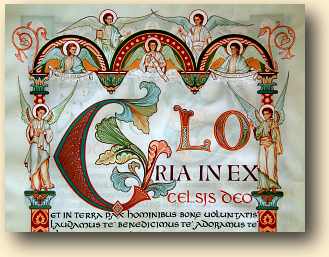
The genius of the Latin Rite should be respected. The triple repetition is one of its characteristics. Examples are "mea culpa, mea culpa, mea maxima culpa"; "Kyrie eleison, Christe eleison. Kyrie eleison". "Agnus Dei qui tollis...", three times. A close study of the "Gloria in Excelsis Deo" also shows "triplets". Translations should neither kill nor flatten out such a characteristic.

The Latin liturgy expresses not only facts but also our feelings, our sentiments, for example, in front of God's transcendence, majesty, mercy and boundless love (cf Liturgiam Authenticam, 25). Expressions like "Te igitur, clementissime Pater", "Supplices te rogamus", "Propitius esto", "veneremur cernui", "Omnipotens et misericors Dominus", "nos servi tui", should not be deflated and democratized by some translating iconoclast. Some of these Latin expressions are difficult to translate. The best experts in liturgy, classics, patrology, theology, spirituality, music and literature are needed so that translations beautiful on the lips of holy Mother Church can be worked out. Translations should reflect that reverence, gratitude and adoration before God's transcendent majesty and man's hunger for God which are very clear in the Latin texts. Pope Benedict XVI in his Message to the meeting of the "Vox Clara" English Committee on 9 November 2005, speaks of translations which "will succeed in transmitting the treasures of the faith and the liturgical tradition in the specific context of a devout and reverent Eucharistic celebration" (in Notitiae, 471-472 (Nov-Dec 2005) p. 557).

Many liturgical texts are steeped in biblical expressions, signs and symbols. They resonate with prayer patterns that date back to the Psalms. The translator cannot afford to ignore this.

A language spoken by millions of people today will undoubtedly have many shades and variations. There is a difference between English used in the Constitution of a country, that spoken by the President of a Republic, the conversational language of dock workers or students and the conversation between parents and children. The manner of expression cannot be expected to be the same in all these situations, although all are using English. What form should liturgical translations adopt? No doubt liturgical vernacular should be intelligible and easy to proclaim and to understand. At the same time it should be dignified, sober, stable and not subject to frequent change. It should not hesitate to use some words not generally in use in every-day conversation, or words that are associated with Catholic faith and worship. Therefore it should say chalice and not just cup, paten and not plate, ciborium and not vessel, priest and not presider, sacred host and not consecrated bread, vestments and not dress. Therefore Liturgiam Authenticam says: "While the translation must transmit the perennial treasury of orations by means of language understandable in the cultural context for which it is intended, ... it should cause no surprise that such language differs somewhat from ordinary speech" (n.47).

Intelligibility should not be pushed to mean that every word must be understood by everybody at once. Just look carefully at the Credo. It is a "symbol", a solemn summary statement, on our faith. The Church has had to call some General Councils for an exact articulation of some articles of our faith. Not every Catholic at Mass will immediately understand in full such normal Catholic liturgical formulae as Incarnation, Creation, Passion, Resurrection, Consubstantial with the Father, Proceeding from the Father and the Son, Transubstantiation, Real Presence, Transcendent and omnipotent God. This is not a question of English, or French, or Italian, or Hindi, or Kiswahili. Translators should not become iconoclasts who destroy and damage as they go along. Everything cannot be explained during the liturgy. The liturgy does not exhaust the entire life activity of the Church (cf Sacrosanctum Concilium, 9). There is also need for theology, catechetics and preaching. And even when a good catechesis has been delivered, a mystery of our faith remains a mystery.

Indeed, we can say that the most important thing in divine worship is not that we understand every word or concept. No. The most important consideration is that we stand in reverence and awe before God, that we adore, praise and thank him. The sacred, the things of God, are best approached with sandals off.

In prayer, language is primarily for contact with God. No doubt, language is also for intelligible communication between us humans. But contact with God has priority. In the mystic, such contact with God approaches and sometimes reaches the ineffable, the mystical silence where language ceases.

There is therefore no surprise if liturgical language differs somewhat from our every-day language. Liturgical language strives to express Christian prayer where the mysteries of Christ are celebrated.

As if putting together these various elements needed in order to produce good liturgical translations, let us quote from the address of Pope John Paul II to American Bishops from California, Nevada and Hawaii during their 1993 ad limina visit to Rome. He was asking them in translations to guard the full doctrinal integrity and beauty of the original texts: "One of your responsibilities in this regard is to make available exact and appropriate translations of the official liturgical books so that, following the required review and confirmation by the Holy See, they may be an instrument and guarantee of a genuine sharing in the mystery of Christ and the Church: lex orandi, lex credendi. The arduous task of translation must guard the full doctrinal integrity and, according to the genius of each language, the beauty of the original texts. When so many people are thirsting for the Living God -- whose majesty and mercy are at the heart of liturgical prayer -- the Church must respond with a language of praise and worship which fosters respect and gratitude for God's greatness, compassion and power. When the faithful gather to celebrate the work of our Redemption, the language of their prayer -- free from doctrinal ambiguity and ideological influence -- should foster the dignity and beauty of the celebration itself, while faithfully expressing the Church's faith and unity" (in Insegnamenti di Giovanni Paolo II, XVI, 2 (1993) p. 1399-1400).

From the above considerations, it follows that the Church needs to exercise careful authority over liturgical translations. The responsibility for the translation of texts rest on the Bishops' Conference which submits them to the Holy See for the necessary recognitio (cf SC 36; CLC Canon 838; Lit. Authenticam, 80).

It follows that no individual, even a priest or deacon, has authority to change the approved wording in the sacred liturgy. This is also common sense. But sometimes we notice that common sense is not very common. So Redemptionis Sacramentum had to say expressly: "The reprobated practice by which priests, deacons or the faithful here and there alter or vary at will the texts of the Sacred Liturgy that they are charged to pronounce, must cease. For in doing thus, they render the celebration of the Sacred Liturgy unstable, and not infrequently distort the authentic meaning of the Liturgy" (Red. Sacramentum, 59; cf also General Instruction on Roman Missal, n. 24).

8. What is expected of us?

As we seek to conclude these reflections, we can ask ourselves what is expected of us.

We should do our best to appreciate the language which the Church uses in her liturgy and to join our hearts and voices to them, according as each liturgical rite may indicate. All of us cannot be Latin speakers, but the lay faithful can at least learn the simpler responses in Latin. Priests should give more attention to Latin so that they celebrate Mass in Latin occasionally. In big churches where there are many Masses celebrated on a Sunday or Feast day, why can one of those Masses not be in Latin? In rural parishes a Latin Mass should be possible, say once a month. In international assemblies, Latin becomes even more urgent. It follows that seminaries should discharge carefully their role of preparing and forming priests also in the use of Latin (cf October 2005 Synod of Bishops, Prop. 36).

All those responsible for vernacular translations should strive to provide the very best, following the guidance of relevant Church documents, especially Liturgiam Authenticam. Experience shows that it is not superfluous to remark that priests, deacons and all others who proclaim liturgical texts, should read them out with clarity and due reverence.

Language is not everything. But it is one of most important elements that need attention for good and faith-filled liturgical celebrations.

It is an honor for us to be allowed to become part of the voice of the Church in her public prayer. May the Most Blessed Virgin Mary, Mother of the Word made flesh whose mysteries we celebrate in the sacred liturgy, obtain for all of us the grace to do our part to join in singing the praises of the Lord both in Latin and in the vernacular.

Monday, November 13, 2006

Here's a thought

From one who should know. =)
A no hold's barred commentary from www.malaysia-today.net's ever combative Raja Petra Kamarudin.

Read it, soak up the irony and be edified.
 

Yay! I'm not a heretic

Yay!

Your's truly is not a heretic.
100% Chalcedon Compliant in fact =)

Are you a heretic?

Click here to find out.

I'm tagging Mark, Mark, Fr. Paul and Francis.

I wonder who the heretic is gonna be ... ; ) hehe.

I am kinda worried about my Nestorian, Apollanarian, Adoptionist and Pelagian tendencies though.
I am glad that I am 0% Arian. Perhaps those long conversations with the Jehovah's Witnesses and Muslims did come in handy after all, in a negative reinforcement sort of way.

Perhaps a visit to my Dogmatic Theology Professor and a re-read of Ludwig Ott, Leo's Tome, Augustine's De Trinitate and Ireneus' Adversus Haereses is in order.


You scored as Chalcedon compliant. You are Chalcedon compliant. Congratulations, you're not a heretic. You believe that Jesus is truly God and truly man and like us in every respect, apart from sin. Officially approved in 451.

Chalcedon compliant

100%

Apollanarian

58%

Nestorianism

58%

Pelagianism

50%

Adoptionist

50%

Gnosticism

25%

Socinianism

8%

Docetism

0%

Arianism

0%

Monophysitism

0%

Monarchianism

0%

Albigensianism

0%

Modalism

0%

Donatism

0%

Are you a heretic?
created with QuizFarm.com

Thursday, November 09, 2006

The College General Major Seminary Chapel of the Sacred Heart


Here's some pics from the Major Seminary for West Malaysia, covering the Dioceses of Penang and Malacca-Johore and the Archdiocese of Kuala Lumpur.
The current seminary is actually the old retreat house of the French MEP Fathers and is formally known as Mariophile. The Seminary Chapel and the old Fathers' House are part of the original buildings. The House now houses the Seminary Museum containing relics of a bygone era such as birettas, candle sticks and a Monstrance Throne. =)
There are many many altar stones from the post V2 years as well, when the High Altars, built with the pennies earned by the sweat of the simple faithful were stripped and smashed.

The former seminary, located on prime land, was sold by the Bishop and converted into a multi billion ringgit mall/residential complex with a hotel coming up soon.

The former St. Joseph's Teacher's Training College, for the Christian School Brothers, with its Chapel was also sold recently and is due to be demolished for a planned commercial development project.

The College General Major Seminary is about a 10 min walk from my house.
Most of the daily Masses are early in the morning. However, the Monday Masses are in the evening so I make it a point to try to rush home from the office(about 20KM away) to join the Fathers and seminarians for Mass as well as the chanting of Vespers.

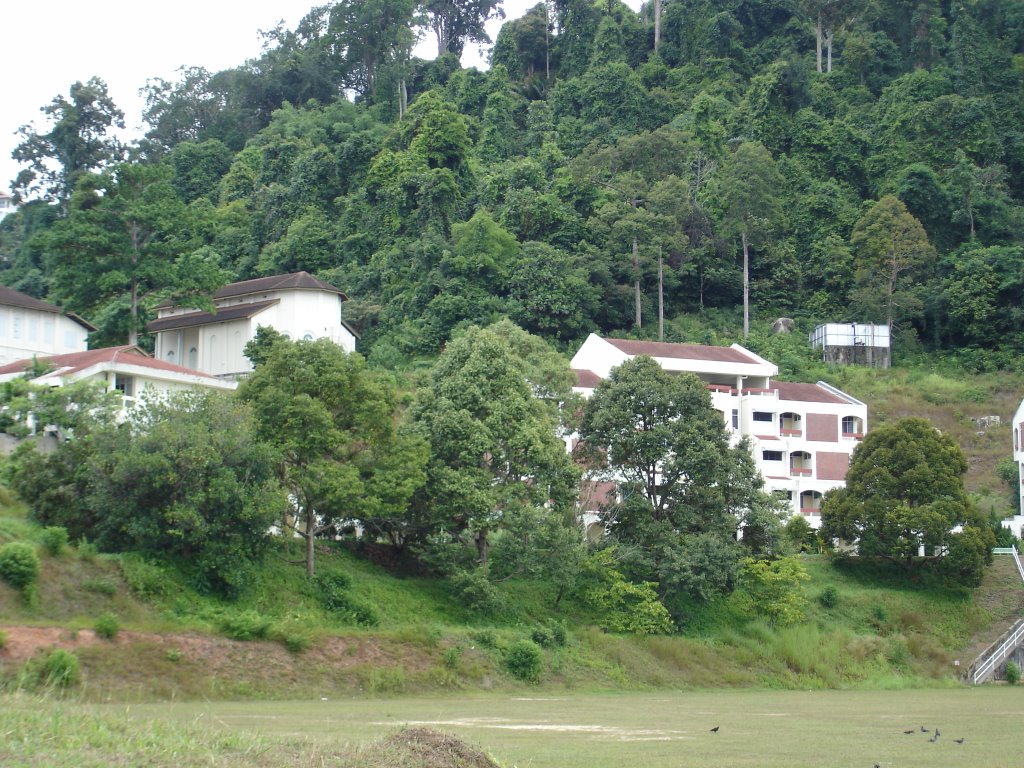
The pic above shows the chapel from the field. Its the building on the top left corner. The residential block for the Fathers and students can seen on the right. This is one of 3 similar blocks but the other 2 are empty of course, due to the drop in vocations.


The interior, from the main door, can be seen next. The seminarians were setting up the Chapel for Mass.

Above the door, is the stained glass rose window depicting the Blessed Virgin, Crowned and with the Christ Child being adored by the saints and angels in Heaven.

Part of the vaulted ceiling can be seen as well.


A close-up.


We see the main altar next. The Tabernacle, is now veiled. Need to get a pic of that.
Above the Tabernacle, the statue of the Sacred Heart.


A close-up.


Note the hanging Tabernacle lamp.

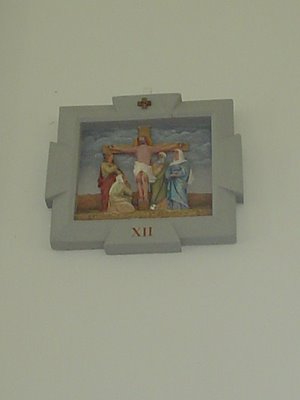
Here's an example of the Stations of the Cross, showing Station 12, the Crucifixion.


Next, we can see the South Side Altar. Above is the image of St. Phillip Minh, a student of the college who was martyred in Vietnam. He was canonized by Pope John Paul II in 1988.
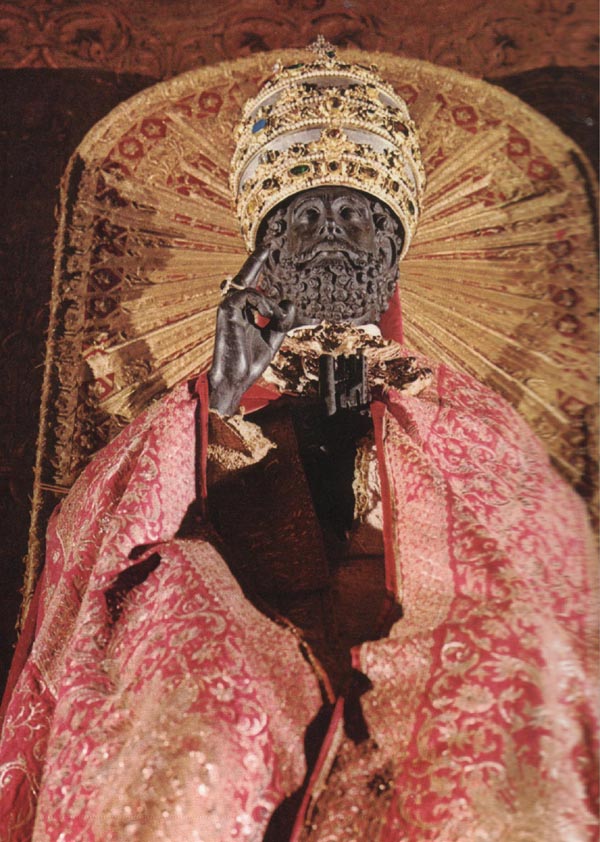


The old High Altar can be seen below.
The relics of many saints and martyrs are placed here for veneration.


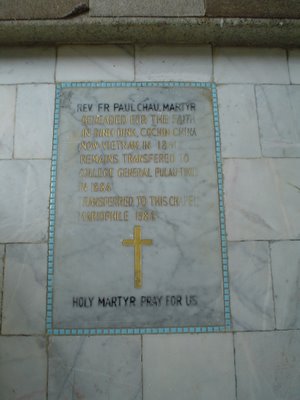
On the step before the altar is the memorial to another former student, Fr. Paul Chau, a martyr.
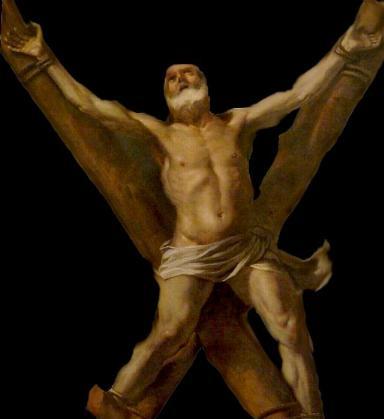

The plaque commemorating the College Saints can be seen below:


Saint Jacques Chastan was a former priest in my parish.
Cool eh?

The North Side Chapel contains another altar with the relics of the martyrs and saints.


The statue of Mary, with a baldaquin.


More pics from the Seminary to come.

Monday, November 06, 2006

Persecution in the Books of the Maccabees

Introduction – the period of 1st and 2nd Maccabees

During the period covered by the Books of 1st and 2nd Maccabees, the Jews were no longer masters of their own destiny or of the Land promised to them by God through Abraham, Isaac and Jacob, their fathers. Successive invasions had decimated the last remnants of the Davidic Kingdom and finally overrun it altogether resulting in the destruction of the Temple of Solomon and the Babylonian Exile after the fall of the southern Kingdom of Judah, leading to foreign occupation and domination of the Promised Land. Throughout all these persecutions and genocides, the Israelites faithfully preserved their faith in the One God, He who had liberated them from bondage in Egypt and brought them to the land promised their Fathers, flowing with milk and honey. It was this Faith in the One God and in the belief that they were His chosen people and firstborn amongst the nations that sustained them, along with the promise of the gathering of the Dispersion and a future Deliverer, a Messiah-King, anointed by God and foretold by His Prophets that would liberate them and once again restore the Davidic Kingdom in perpetuity.

After the Return and the rebuilding of the 2nd Temple in Jerusalem, a new and more insidious threat was beginning to take shape. This was not the wars, invasions and ethnic cleansings of the past where the aim was to possess the Land or to destroy Israel as a people. Those were easy. Fight or die. There was no other choice, no other means of survival. This new threat had, as its mission, the total obliteration of Yahwistic worship and the observance of the Law of Moses, the distinctive and covenantal statutes that distinguished Israel among the nations. The caveat this time was prosperity and honour for those who joined in the religion and lifestyle of the Greeks(1Macc 2:15-18), the conquerors of the known world with their wisdom and their philosophers, their culture and the cult of the Olympian pantheon, the Gods of the conquerors. Refusal and obstinacy? Death by torture to those who wished to hold on to the ways and the God of the defeated, to those who insist on backward and rustic practices of ritual cleanliness, quaint sexual mores and unintelligible dietary prohibitions not to mention the utter silliness of the Sabbath Rest. This was a new phase in Salvation History, a new, explicit test of the Faith of the Israelites in their God and the lengths to which they would go to keep His Law in the face of oppressive and brutal persecution.

In this complex situation of religious, economic and political tensions and turmoil, the actions of the Hellenizing Seleucid King Antiochus Epiphanes, a prototype of the Antichrist, brought things to a head. In his desire to remove the Jewish observances in the Torah which was seen as a source of conflict and potential rebellion within Judea, Antiochus tried to eradicate the distinctive identity of the Jews (1 Macc 1:41). By profaning and plundering the Temple and outlawing the Cult of Yahweh, however, Antiochus instead sparked the first Jewish war of independence as well as the first Jewish martyrdoms as recorded in the 1st and 2nd Books of the Maccabees.

Give the responses made by the Jews at the various stages of the Maccabean crisis.

*Pls note that the answer proper starts here, after the preceding Introduction in page 2

The Jewish Response

The matter stood thus. Antiochus Epiphanes decreed that the Jews “forsake the laws of their ancestors and no longer to live by the laws of God (2Macc 6:1)”. This is elaborated in 1Macc 1:44-49 where “he directed them to follow customs strange to the land, to forbid burnt offerings and sacrifices and drink offerings in the sanctuary, to profane Sabbaths and festivals, to defile the sanctuary and the priests, to build altars and sacred precincts and shrines for idols, to sacrifice swine and other unclean animals, and to leave their sons uncircumcised. They were to make themselves abominable by everything unclean and profane, so that they would forget the law and change all the ordinances.” The choices faced by the Jews were simple. “Whoever does not obey the command of the king shall die” (1 Macc 1:50). In the midst of these harrowing trials and tribulations unleashed by Antiochus, several options were open to the Jews. To resist was to condemn self and family to persecution by the occupying powers and ultimately death. To capitulate meant apostasy from the Faith of their Fathers and the God who rescued them from Egyptian bondage.

Resistance

Heroic Fidelity to the point of Martyrdom

For many of the Jews, the Law of Moses was what identified them as a people and set them apart from the nations around them. The One-ness of God as professed in the Shema (Deut 6:4) was also a distinctive among the polytheists in whose midst they lived. Trials and tribulations dot the history of Israel. Divine chastisement followed disobedience and the Covenantal fidelity of Yahweh and His final triumph over the enemy as related in the History of Israel in the Books of the Judges, Kings and Chronicles and foretold by the Prophets are things that were embedded in the Jewish psyche. So, for many, there was never really any choice to make. If fidelity meant death, then so be it for, for the Jews, God would raise them for their steadfastness while apostasy meant eternal loss.

Passive resistance and disobedience

The books of the Maccabees abound with examples of heroic fidelity to God and His Law. These did not take arms against the aggressors, because they were fully conscious that they were “suffering these things on our own account, because of our sins against our own God” (2nd Macc 7:18). Rather, they submitted to the torments in the hope that their suffering might serve an atoning, propitiating and expiatory purpose to placate the “wrath of the Almighty that has justly fallen on [their] whole nation” (2nd Macc 7:38) and induce Him to show mercy on Israel. (2nd Macc 7:18, 32-38. Esp. vv37- 38) Three well known examples will suffice to illustrate this form of response.

The martyrdom of Eleazar the aged and prominent Scribe (2nd Macc 6:18-31) shines forth like a beacon during the darkness Antiochene persecution. Even the “natural love of life” (2nd Macc 6:20) could not induce him to profane himself by eating anything unclean. What further stands out is his refusal to put on a show, consuming clean meat on the pretext of eating the unclean for the illuminating reason to “leave to the young a noble example of how to die a good death willingly and nobly for the revered and holy laws” (2nd Macc 6:28, cf 31).

The story of the mother and her seven children(2nd Macc 7: 1-42) who “are ready to die rather than transgress the laws of [their] ancestors” is another example of heroic fidelity to God and His law that has edified and inspired generations of martyrs in faithfulness to the shedding of their blood. Their hope in the justice of God and in the resurrection of the dead to eternal life and glory (2nd Macc 7:9, 14) as well as the Divine retribution in store for those that maltreat God’s own permeates their words and inspires their heroic deaths. They recognized the Creator as the giver of life and all its gifts and esteem the Gift-giver ahead of all His gifts (2nd Macc 7:11, 22-23) holding nothing of themselves back to glorify His Name “because of [their] hope in the Lord” (2nd Macc 7:20).

Two deserve special mention here, the mother and the youngest son. The example of the youngest son serves as a model of fidelity to God for the Church as well as us Christians today in his steadfastness when compromise and ‘accommodation’ would serve to not only preserved his earthly life but gain material wealth and power. Even when promised to be made “rich and enviable” if he “would turn from the ways of his ancestors”, and that the King “would take him for his Friend and entrust him with public affairs” (2nd Macc 7:24), the boy refused, preferring instead to die in the Faith of his Fathers and the friendship of God, hoping for a resurrection to life(v 14).

The mother shows the kind of selflessness that is the hallmark of one conscious of her own creatureliness and the transcendence of her Creator. “Although she saw her seven sons perish within a single day, she bore it with good courage because of her hope in the Lord” (2nd Macc 7:20). What could possibly induce a mother to forsake all her maternal instincts and encourage her youngest son to defy the King and suffer martyrdom? It was firstly the recognition that “it was not [she] who gave [her children] life and breath”(2nd Macc 7:22) and secondly and more importantly, she was animated by her confidence in the Creator who “gave [them] life and breath” and “will in his mercy give life and breath back to [them] again, since [they] now forget [themselves] for the sake of his laws” (2nd Macc 7:23). It is for this reason that, forsaking her maternal instincts, she calls them to be martyrs (witnesses) of the Faith and ‘accept death, so that in God's mercy [she] may get [them] back again" (2nd Macc 7:29).

The third example is the martyrdom of Razis (2nd Macc 14:37-46), the “Father of the Jews” and elder in Jerusalem. He took his own life, preferring “to die nobly rather than to fall into the hands of sinners” (2nd Macc 14:42). His manner of death might be different but his motivation and hope was the same as he gave up his life “calling upon the Lord of life and spirit to give them back to him again” (2nd Macc 14:46).

These were not the only ones who clung to the Law of God and their fathers. “Many in Israel stood firm and were resolved in their hearts not to eat unclean food. They chose to die rather than to be defiled by food or to profane the Holy Covenant; and they did die” (1 Macc 1:62-63).

Armed Resistance

When the prohibition of the Jewish Laws was first decreed by Antiochus and the people saw that fidelity meant death, many in Israel, esteeming the Law of their Fathers, went “into hiding in every place of refuge they had” (1 Macc 1:53 and also 2:29). These people, driven into a corner, resolved to fight. However, those resolved to take arms are faced with the same dilemma faced by modern Israel during the Yom Kippur War. When attacked by their enemies during the Sabbath, the very Law that they swore to uphold meant death to them. Early in the struggle, many esteemed the observance of the Sabbath over their lives. When surrounded by the King’s armies and forced to fight, they said, “’we will not come out, nor will we do what the king commands and so profane the Sabbath day.’ Then the enemy quickly attacked them. But they did not answer them or hurl a stone at them or block up their hiding places, for they said, "Let us all die in our innocence; heaven and earth testify for us that you are killing us unjustly." So they [the King’s forces] attacked them on the Sabbath, and they died, with their wives and children and livestock, to the number of a thousand persons.” (1 Macc 2:34-38. See also 2nd Macc 6:11)

Mattathias and other resistors soon came to the realization that "if [they] all did as [their] kindred have done and refuse to fight with the Gentiles” they will be quickly destroyed from the earth. So they made this decision that day: "Let us fight against anyone who comes to attack us on the Sabbath day; let us not all die as our kindred died in their hiding places." (1 Macc 2:39-41)

From this fateful decision, began the famous wars led by Mattathias and Judas Maccabeus and his brothers Jonathan and Simon after him. “They organized an army, and struck down sinners in their anger and renegades in their wrath; the survivors fled to the Gentiles for safety. And Mattathias and his friends went around and tore down the altars; they forcibly circumcised all the uncircumcised boys that they found within the borders of Israel. They hunted down the arrogant, and the work prospered in their hands. They rescued the law out of the hands of the Gentiles and kings, and they never let the sinner gain the upper hand. (1 Macc 2:44-48).

These wars and armed resistance by those committed to upholding the Law resulted is the re-Dedication of the Temple, Jonathan appointed High Priest, the restoration of many privileges and religious rights as well as the celebration of the Jewish Festivals and finally resulting the independence of Judea “from the yoke of the Gentiles” (1 Macc 13:41).

The driving motivation for these acts is summarized by Judas himself, echoing David before facing Goliath and foreshadowing St. Paul, in 1 Macc3:19-22: “It is not on the size of the army that victory in battle depends, but strength comes from Heaven. We fight for our lives and our laws. God himself will crush them before us;”

But the negative aspect of these wars and their outcome are the increasing secularization of the office of High Priest under Jonathan and Simon who functioned more as military and executive leaders rather than religious ones, assuming secular dress, titles such as ‘ethnarch’ and warlike powers whilst neglecting their priestly duties not to mention making covenants with Gentiles such as the Romans, Spartans and others.

Craven capitulation, apostasy and betrayal

After these luminaries, we number the apostates, those whose response to adversity and trial was to betray the Faith of their Fathers and their own people. Some did this under pain of torture but some “renegades”, even prior to the Antiochene decree, voluntarily petitioned the King to observe the ordinances of the Gentiles (1 Macc 1:13). These came to be called the Hellenizers, taking their name from the Hellenic or Greek practices and culture that they adopted such as building a gymnasium and removing the marks of circumcision.

After the Antiochene decree, “Many of the people, everyone who forsook the law, did evil in the land;” (1 Macc 1:52). “Many even from Israel gladly adopted [the King’s] religion; they sacrificed to idols and profaned the Sabbath” (1 Macc 1:43). An example would be the “Jew [who] came forward in the sight of all to offer sacrifice on the altar in Modein, according to the king's command” (1 Macc 1:23).

Betrayers also arose. Among them we number Alcimus, leader of “all the renegade and godless men of Israel” (1 Macc 7:5) who “brought to the king accusations his people”. In the same line is named “Simon, of the tribe of Benjamin” (2nd Macc 3:4 and 4:1) who invited foreign intervention and slandered Onias the righteous High Priest. Here also is named the Hellenizer Jason, brother of Onias who obtained the High Priesthood through simony (2nd Macc 4:7) and upon his ascension “at once shifted his compatriots over to the Greek way of life” (2nd Macc 7:10) and “destroyed the lawful ways of living and introduced new customs contrary to the law. He took delight in establishing a gymnasium and induced the noblest of the young men to wear the Greek hat. There was such an extreme of Hellenization and increase in the adoption of foreign ways because of the surpassing wickedness of Jason, who was ungodly and no true high priest, that the priests were no longer intent upon their service at the altar” (2nd Macc 7:12-14). In this line is also named Menelaus and Alcimus pretenders to the office of High Priest who through their scheming had brought misery and misfortune on the Jewish people.

Here, we also list the Quisling collaborators. Numbered among this groups are “the Hasideans [who] were first among the Israelites to seek peace from” Alcimus and his band. Their reward for collaborating is given in (1 Macc 7:12-17). We also list the response of “some of the priests from the sanctuary and some of the elders of the people came out to greet him [Nicanor] peaceably and to show him the burnt offering that was being offered for the king”. These also were rewarded mockery and derision.

Conclusion

As in ages past, God’s family, the Church today, is buffeted by storms and all manner of tempests as, guided by the Successor of the Rock on which Christ built His Church, she sails into the consummation of the age.

The Promise that the Gates of Hades will not prevail contains no provisions that the Gates of Hades will not try. As such, the responses of the Jewish people in the face of threats, trials and tribulations as was entailed in the Maccabean Crisis must not merely serve as a quaint footnote in our study of the Sacred Scriptures but must serve as a living model and an example for us Christians today. Let us not only be inspired by the heroic witness of those who obtained the crown of martyrdom in the hope of the Resurrection and in the Justice of a Righteous God but also learn from the cautionary example of those who, by ignoring God and forsaking His Covenant by looking for earthly glory and power, forfeit all hope of eternal bliss and a resurrection to life.


Unless otherwise noted, all Scripture readings taken from the New Revised Standard Version, Catholic Edition. Copyright © 1989, Division of Christian Education of the National Council of the Churches of Christ in the United States of America.


The Prophets of Israel

I'm posting a very brief(cos we were constrained by the number of pages we could write) assignment I wrote on the institution of the Prophets in ancient Israel, focusing on the message of the Prophet Amos for one of my courses.

Who are the Prophets of Israel?

When we normally hear the word ‘prophet’, the first thing that springs to mind is a seer, a foreteller of events to come, a person able to predict the future or even a harbinger of doom and God’s judgement. In the history of Salvation, the LORD was pleased to call several men to become His prophets to the people of Israel. Who were these chosen ones and what was their office?
A reading of the Scriptures show that this stereotype of the prophet, although containing some truthful elements, does not entirely capture its office and function in their fullness.
A Prophet of Israel was not merely a man enlightened by the LORD to foretell events; he was also the interpreter and herald sent by the LORD to communicate His will and designs to Israel. His mission consisted in acting as God’s spokesman, proclaiming God’s will as well as in foretelling what was to come.1

Among his numerous duties were to preserve and promote the adherence of the Torah among the people of Israel, reminding them of the Covenant, calling Israel and her leaders to repentance and leading them back when they strayed by promise of blessings, to reward obedience and threatening God’s wrath and calling down the Covenant curses in the case of apostasy. Another important part of the prophet’s job was to gradually prepare the way for the new Kingdom of God, which the Messiah was to establish on earth. 2
The word "prophet" comes from the Greek prophetes, from pro ("before" or "for") and phemi ("to speak").3 The prophet is thus the one who speaks before in the sense of proclaim, or the one who speaks for, i.e., in the name of (God). The ordinary Hebrew word for prophet is nabî'.4

Biblically, the criteria set by the LORD for a prophet are layed out in the Book of Deuteronomy, chapter 13, verses 1-3 and chapter 18, verses 14-22. In summary, a true prophet of God:

-is one who receives a specific and personal call from the LORD and is sent by Him; (Dt 18:15)5
-encourages loyalty to the LORD and to his revelation and condemns apostasy; (Dt 18:13)6
-is a Hebrew who addresses himself primarily to Israel; (Dt 18:18)7
-speaks in the Name of the LORD as His spokesman;(Dt 18:19)8
-authenticates his mission with "signs" that come to pass (Dt 18:22).9

The prophetical office was not hereditary like that of priests and kings. The prophetic call usually came suddenly. The prophet knew the day and the moment when revelation first came to him. Prophets came from all vocations in life as some were priests, others princes, others shepherds, others farmers, etc. The essence of the prophetical office consisted in a God-given message and mission: "For prophecy came not by the will of man at any time, but the holy men of God spoke, inspired by the Holy Ghost" (2nd Peter 1:21).

Revelation came to the prophets in three ways:
by an external image perceived by the senses of the prophet; for example, the burning bush of Moses or the handwriting on the wall of Balthasar's banquet hall;
by an internal image perceived by the prophet in a vision, dream or ecstasy;
by words spoken directly to the prophet. The prophets frequently explained the message to the people or acted it out for them.

The Prophetic books of the Bible are customarily classified into Major Prophets (Isaiah, Jeremiah, and Ezekiel) and Minor Prophets (Hosea, Joel, Amos, Obadiah, Jonah, Micah, Nahum, Habakkuk, Zephaniah, Haggai, Zechariah, and Malachi). Chronologically, the prophets may be divided into four groups: (1) Amos, Hosea, Micah, and Isaiah, active in the 8th century BC; (2) Nahum, Zephaniah, Habakkuk, and Jeremiah, immediately pre-exilic (late 7th to early 6th century); (3) Ezekiel and Second Isaiah, exilic period; (4) the post-exilic prophets. The prophetic tradition, however, goes back at least as far as Samuel and includes such early figures as Elijah and Elisha.10


What is the main message of Amos?


The Prophet Amos was a shepherd from Tekoa in Judah but who prophesied mainly in the northern kingdom of Israel. His prophetic ministry was exercised during the reign of King Jeroboam II of Israel and King Uzziah of Judah. This was a time of prosperity for both Israel and Judah but despite this prosperity, the poor were oppressed by the rich and the gap between rich and poor became very pronounced.
Amos’ message was a very visual message, full of imagery that the people would immediately understand. It was a message of social justice, calling forth the LORD’s judgement on the rich for their outward manifestation of empty religiosity by means of ritual but oppressing Yahweh’s people.

The prophet Amos’ concept of God is fundamental to understanding his message. He views the LORD not merely as passive Creator of the heavens and the earth who then leaves men to their own devices. Amos sees God as an active sustainer, omnipotent and in control of all things. He controls the destinies of the nations and is the final and ultimate Judge of all who is Just. Amos proclaims that Israel is the elect of God through her Covenantal relationship with Him. Through the Prophets, she knows the will of the LORD and all His Laws. As such, she is all the more guilty when she knowingly and willingly violates the Covenant and partakes in the iniquities and immoral acts of her pagan neighbours.11 Thus her judgement will be all the more severe compared to the other nations.

Amos indicts Israel for unfaithfulness to her Covenant with God. She refused to turn back to the LORD even after He chastises her with many punishments12 Amos thus warns Israel of the impending Judgement because the LORD cannot overlook her trespasses indefinitely because He is Just and Holy by His Divine Nature, He is Yahweh Sabaoth, the LORD of Hosts who is Omnipotent and in control.
However, the main message of the Prophet Amos is that a broken law cannot be amended by means of ritual, festival or offering alone. The crime of Israel is that the poor and downtrodden continue to be oppressed and can find no justice.13,14,15,16

The most elaborate ritual is an abomination to Him when offered by people with no intention of keeping his moral commands. Such a religion of outward ceremonies and ritual was an abomination to God when practiced apart from righteousness.
Thus, Amos’ main concern was to demand righteousness in the name of the LORD for His people. This righteousness was the most important attribute of Yahweh. The LORD spurns, even hates all the sacrifices and offerings offered to Him because the people continued to sin.

The Israelites had religious assemblies where they offered burnt offerings to honour the LORD with grain offerings and fellowship offerings to implore His favour. They offered fat animals and worshipped with music and songs. However, with this worship, the people hoped to obtain permission to continue sinning.17

They wished for the end of the festivals and the Sabbath so they can continue oppressing the poor and make more money for themselves.18

In Amos 5:25, we have the startling question from the LORD: “Did you offer victims and sacrifices to me in the desert for forty years, O house of Israel?” The LORD goes on to say that He hates these things which offend Him as the sacrifice of the wicked is an abomination.19

The Law of Sacrifices is meaningless without an interior disposition of righteousness.20 What the LORD requires is that the people be filled Justice and Righteousness which should mark their every dealing and guide their lives. Only with the correct interior disposition will their sacrifices be pleasing to the LORD.

In our own time, we are becoming more and more affluent, and morality, especially among the Western nations and the rich continues to decay. Many of our own Catholics and Christians practice a ritualistic religion and come to Mass only to fulfill their Sunday obligation, eager to put in their one hour’s worth and get back to their lives, complaining when the sermon is overly long, complacent in their membership of the Church. Many outwardly observe the rituals but are not righteous in the sight of God because of their apathy in the face of the poverty and suffering of their fellow man. Our time parallels much of the times of the Prophet Amos and we too must take heed of his message lest the calamities threatened by the LORD befall us also because of our poor spiritual state. Our punishment will also be all the greater because like Israel of old, we know the Law of Truth spoken to us by Jesus Christ and His Church and willingly and knowingly disobey.

References
The Catholic Encyclopedia, 1917 Edition
IVP New Bible Dictionary-3rd Ed, Inter Varsity Press
Catechism of the Catholic Church, Liberia Editrice Vaticana, 1994
Matthew Henry Bible Commentary, Zondervan Publishers
A Catholic Guide to the Bible, Fr Oscar Lukefahr, Liguori Publications
Elwell Evagelical Dictionary of Theology-2nd Ed, Baker Book House Co.

All Scripture quotations from the Douay-Rheims Version, Challoner Revision, 1899 Edition

1 A Catholic Guide to the Bible, pg118
2 cf Catechism of the Catholic Church, hence CCC 64, 218
3 Prophet, Elwell Evangelical Dictionary of Theology
4 Prophet, Catholic Encyclopedia, 1917 Edition
5 Deu 18:15 The Lord thy God will raise up to thee a prophet of thy nation and of thy brethren like unto me: him thou shalt hear:
6 Deu 18:13 Thou shalt be perfect, and without spot before the Lord thy God
7 Deu 18:18 I will raise them up a prophet out of the midst of their brethren like to thee: and I will put my words in his mouth, and he shall speak to them all that I shall command him.
8 Deu 18:19 And he that will not hear his words, which he shall speak in my name, I will be the revenger.
9 Deu 18:22 Thou shalt have this sign: Whatsoever that same prophet foretelleth in the name of the Lord, and it cometh not to pass: that thing the Lord hath not spoken, but the prophet hath forged it by the pride of his mind: and therefore thou shalt not fear him.
10 Prophecy, Prophets, IVP New Bible Dictionary-3rd Ed, pg 968
11 Amo 3:2 You only have I known of all the families of the earth: therefore will I visit upon you all your iniquities.
12 Amo 4:6-11 "I was the one who brought famine to all your cities, yet you did not come back to me. I kept it from raining when your crops needed it most. I sent rain on one city, but not on another. Rain fell on one field, but another field dried up. Weak with thirst, the people of several cities went to a city where they hoped to find water, but there was not enough to drink. Still you did not come back to me. "I sent a scorching wind to dry up your crops. The locusts ate up all your gardens and vineyards, your fig trees and olive trees. Still you did not come back to me. I sent a plague on you like the one I sent on Egypt. I killed your young men in battle and took your horses away. I filled your nostrils with the stink of dead bodies in your camps. Still you did not come back to me. "I destroyed some of you as I destroyed Sodom and Gomorrah. Those of you who survived were like a burning stick saved from a fire. Still you did not come back to me," says the LORD.
13 Am 2:6-8: Thus saith the Lord: For three crimes of Israel, and for four I will not convert him: because he hath sold the just man for silver, and the poor man for a pair of shoes. They bruise the heads of the poor upon the dust of the earth, and turn aside the way of the humble: and the son and his father have gone to the same young woman, to profane my holy name. And they sat down upon garments laid to pledge by every altar: and drank the wine of the condemned in the house of their God.
14 Amo 4:1 Hear this word, ye fat kine that are in the mountains of Samaria: you that oppress the needy, and crush the poor: that say to your masters: Bring, and we will drink.
15 Amo 5:10-13 They have hated him that rebuketh in the gate: and have abhorred him that speaketh perfectly. Therefore because you robbed the poor, and took the choice prey from him: you shall build houses with square stone, and shall not dwell in them: you shall plant most delightful vineyards, and shall not drink the wine of them. Because I know your manifold crimes, and your grievous sins: enemies of the just, taking bribes, and oppressing the poor in the gate. Therefore the prudent shall keep silence at that time, for it is an evil time.
16 Amo 8:4 Hear this, you that crush the poor, and make the needy of the land to fail,
17 Amo 4:4 Come ye to Bethel, and do wickedly: to Gilgal, and multiply transgressions: and bring in the morning your victims, your tithes in three days. And offer a sacrifice of praise with leaven: and call free offerings, and proclaim it: for so you would do, O children of Israel, saith the Lord God.
18 Amo 8:5-6 You say to yourselves, Saying: When will the month be over, and we shall sell our wares: and the sabbath, and we shall open the corn: that we may lessen the measure, and increase the sicle, and may convey in deceitful balances, That we may possess the needy for money, and the poor for a pair of shoes, and may sell the refuse of the corn?
19 Amo 5:21-23 I hate, and have rejected your festivities: and I will not receive the odour of your assemblies. And if you offer me holocausts, and your gifts, I will not receive them: neither will I regard the vows of your fat beasts. Take away from me the tumult of thy songs: and I will not hear the canticles of thy harp.
20 Amo 5:24 But judgment shall be revealed as water, and justice as a mighty torrent.


Wednesday, June 28, 2006

Priestly Vocations in the Catholic Church

Reading the thoughts expressed below by Kenneth Gan, methinks that a response is in order.

>We recently celebarted World Day of Prayer for Vocation. A rather good
>promotion of the various religious orders and priesthood was in the herald
>(singapore catholic news was better). The promotions was glamorous, very
>contemparary.
The Church i go to in KL also had a very modern promotion of
>vocation, using LCD.
>
I think that the kind of people that the Church should be looking to attract to the priesthood should be more substantive that the ones easily swayed by snazzy packaging. Not in anyway minimizing the importance of proper presentation, or that the Good Lord may not use snazzy and catchy poster to ring out His call, but the subject matter should serve as the attraction itself. What could be more exiting and attractive than in leaving everything and serving the Lord Jesus and His Body, the Church, setting aside our earthly delights for an eternity of beatitude, sacrificing the finite for the infinite?

I believe that a vocation is something thought about thoroughly and over an extended period of time. Not something one decides on seeing a poster, no matter how well presented. Though the numbers to call do come in handy, especially where religious orders are concerned but for diocesan vocations, you would normally approach your parish priest who would then send you to the diocesan vocation director. Even for vocations to the religious life, the normal process would be to meet with and encounter the spirituality and way of life of a particular religious congregation, then contacting them to further explore.

God calls, but He calls through families, through priests and through the Church, not(very often anyway) in a vacuum or through direct personal revelation with the accompanying fireworks.

The promotion of vocations to the priesthood should begin, as it did for much of the history of the Latin Church, in the sanctuaries and by the Altars where boys, standing so close to the Mystery of the Eucharist and observing the Priest in persona Christi yearn to emulate the priests that they admire and serve. It is the priests who should be role models and people whom the young would want to follow. We need to see our priests functioning in their priestly duties and we need to see our priests praying. Not as administrators, clerks and whatnot, but as priests were ordained to be[pun intended]. I would help if we could still identify our priests and religious as such, but with their secular dress and secular mannerisms, they blend in so well, that we do not see them at all. It is by their example, their fidelity to prayer and diligence in administering the Sacraments, their self sacrifice and obedience to rubrics and canonical authority and above all, their love for the Lord and for His Body, the Church. It is by this love that, not only priests, but we all are supposed to be identified for Deus caritas est.

Question. Do we have such priests who are role models? His Holiness Pope John Paul II was one surely. But closer to home. Any priest ring a bell?

Still, these altar boys dont just drop out of the sky. The family, the domestic Church is where the seeds of priestly vocations are planted. Priests come from families that pray, that love the Lord and neighbour, that promotes sacrifice. Its hard for the seeds of God's calling to blossom in the hard ground of families that believe in the Gospel of Wealth and the 5C's (cash, car, condo, credit card and career, but now, in these modern times have been upgraded to the 5 B's [not cash, better to own a Bank, not any old car but a BMW, not a credit card but better be a Billionaire and not just have a career but be the Boss]). When parents uphold these as the ideals for which their children should aspire, then the priesthood must seem a dingy thing indeed. And that would be very true, if we merely believe in this temporal world. If however, parent and children really, and I mean really, really, really, really believe in God and His Church and eternity and Everlasting Life and Heaven and Hell, then serving God in the priesthood, should God call, would be a great and wonderful good above all worldly goods. But only if you really, really, really believe.

>But behind all these, the Church forgets something. Why aren't the Church
>talking about how they treat and respond to those interested in vocation?
>Sometimes the advises given to young discerning candidates are often very
>modern and not 100% Gospel based.


Treading on sensitive ground here, but I think[this is my personal opinion, hence the preceeding 'I think'. Pls don't send out the Liberal Inquisitors!], from anecdotal evidence[again, personal opinion, anecdotal evidence, etc], the very core of the problem is that the type of ppl the local hierarchy of the Church are looking for does not include those that that very traditional, those who know their Faith really well, practice it and are not afraid of their Catholic identity, those who cling to the teaching of the Apostles and handed down through the Magisterium of the Church, those who are wary of those new-fangled liberal doctrines and innovations, those who would like to see dignity and solemnity restored in the celebration of the Mass, where the One Lord and God of all is worshipped and glorified and where we should not be at the centre of attention all the time, those who want accurate renderings of the Latin texts of the Mass, those who do not spurn the Latin Chant and the Latin language, according to the will of the 2nd Vatican Council, which is the patrimony of the Church, those who think that God is glorified in beauty and that only the best that human hands can make and offer is still less that what He deserves, those who obey the words of the Vatican Council and not its so called 'spirit', those who look at Vatican II as one in a line of Ecumenical Councils of the Catholic Church and not a Super-Council above all else, those who interpret the Vatican II conciliar documents in harmony with those that came before, those who profess obedience to the disciplinary authority of the Pope and the Roman dicasteries when they legislate General Norms governing the Liturgy, those who actually believe that Jesus is the Only Saviour, the Way, the Truth and the Life and not one among many ways and truths, those who actually believe that the Church is the Body and Bride of Christ and the Pope, her visible Head on Earth.

These kind of people are labelled dangerous reactionaries pining for the bad old days.

No, these are most definitely not the kind of people the Church is looking for. I think that people who are fuzzy around their doctrinal edges and those whom are willing to be tossed to and fro by any new wind of doctrine emanating from Hans Kung, Charles Curran, John Dominic Crossan and the Tubingen School and whose ears itch to be tickled by relativism, I think that these are the people that the hierarchy, being of like mind, are looking for.

These are serious charges I know. They come from the pen of one tired of fighting a one man uphill battle. Orthodoxy is a dirty word these days and such is the power of the dictatorship of relativism that unless one is as liberal and relativistic as they are, one will be marginalized and made into an ecclesiastical pariah. Fidelity to Rome gets one nowhere these days. But these guys who spurn the very authority that they have sworn to uphold upon ordination now expect us to follow them into heterodoxy where they liberals are the establishment. Those that demand obedience must first show obedience, otherwise no obedience will be shown to them. All this bending of the rules and regulations, if truly leading to vibrant and faith-filled communities where God's gift of life is treasured and where priestly and religious vocations abound, might indeed serve a higher economical purpose in the Divine Plan of Salvation.

But the sad fact of the matter is, that liberal parishes and dioceses are dying off and liberal seminaries where orthodox candidates are unwelcome are closing. The liberal religious orders, where no one dons a habit and all seemed to have lost their identity, are aging and dying off as well. The orthodox dioceses where Catholic truth and Catholic identity are emphasized on the other hand have booming vocations. The newly formed religious orders of an orthodox character have numerous vocations as well.

The sad thing is, with all these liberal priests jumping on the liberal agendas such as women's ordination, all they have to look at is the current mess that the shrinking liberal Protestant denominations are in. The slow motion car wreck that is the Episcopal Church USA or the Presbyterian Church USA are good examples of women's ordination, elevating active homosexuals to the episcopate and renaming the Trinity. The only religious group growing are the Pentecostals and the Muslims which demand strict adherence and a real metanoia. Even though the Pentecostals do not have the fullness of the Gospel such as the Catholic Church possesses, they are still growing for such is the power of the Gospel when allowed to take root and grow. Why then do our liberals want to follow such a self destructive path?

Ask yourself, when is the last time you heard a really good catechetical homily at Mass? The last time, maybe Corpus Christi, when the priest stressed that the Sacred Host is really and truly the Body and Blood, Soul and Divinity of Our Lord Jesus Christ? The last time you heard that Jesus is the Way, the Truth and the Life? What about the distinctive Catholic doctrines such as purgatory, the Immaculate Conception and the Assumption of the Blessed Virgin Mary, the ministerial priesthood, the papacy? What about the unworthy reception of the Eucharist before sacramental confession? What about the "repent and believe in the Gospel" kerygma of the message of Pentecost?

So, its not that the Church does not encourage vocations to the priesthood, but rather the kind of people they local hierarchy are looking for.
If you show signs of traditionalism, they tend to discourage you. But if you believe that all, even Satan will eventually be saved, that Hell does not exist and other foggy nonsense that would have earned the laity a latae sententiae excommunication and bishops a visit to the Holy Office in the days of yore, you'd probably stand a good chance of being admitted to the seminary.

>Very often these treatments by
>Priests/Religious leaves the candidate in the dark; candidates feel
>abandoned.
>
This is part of the process of screening candidates. Live with it or look for a diocese and a bishop where orthodoxy and traditional piety is valued. Thats probably one of the reasons that orthodox bishops have overflowing seminaries. I also know of candidates who sought admittance into the seminary but were discouraged because of their views. Those accepted had to either shut up for the duration of their formation or get into trouble and put into a corner in all their classes with professors threatening to fail them. The sad thing is that most of these people, who know the faith and know it well, had to sit thought insipid and vapid lectures bordering on heresy and seeing the other students get indoctrinated.


>All these are NOT new news. I have Religious who even admits on what goes
>on INSIDE a Religious congragation. An i have heard from
>ex-Priest/Religious that Priest/Re;igious life are no more authentic.
>
So, what's new? The religious life used to be a special call to holiness, as an example to edify, stimulate and inspire others to a life of fidelity to the Gospel and as a testimony of Faith in the Life to come.

>Let me share with you what i was advised recently by some priest and
>religious. Below are some points:
>
>a) Study first, you need something to fall back on if leave or is asked to
>leave the priesthood/religious lfie. = my question: Aren't we supposed to
>100% trust in the Lotd God?
>
In the Lord God you can trust. Its these people that you should look out for. =) In any case, it is good advice as if you're not to their liking and they can't break you, they'll just probably kick you out. If explained properly, its so that you have a useful skill that you might be able to utilize in the priesthood. Legal skills will probably help your canon law career and help you in discussions with the local Majlis ppl. Architectural degrees will help you if you're building or renovating a Church. And perhaps a communications and sales degree will help in homiletics and vocation promotion?

>
>b) Falling in LOVE is a plus. = Question: If you have a Calling and your
>heart is on God, aren't falling in love be unfair to your partner then?
>
>
This is the liberal ploy to make future priests more accommodating to contraception and divorce since they've had 'pastoral experience' in relationships. The partners are collateral damage. In actuality, and if explained properly, you must know what you re giving up before giving it up. Its through experiences like these that we discern our vocation. We should never opt for celibacy, which is a Divine gift, and regret if afterwards with all the 'I wish I hads".

>c) You do now suit todays Priesthood/Religious lfie because i go by the
>SPirit; tradition of the Church and where God lead. = Question: Aren't we
>supposed to be Faithful to Scripture and TRADITIONS? The Church always
>looks forwards forgetting what they are leaving behind.
>
I am not sure at what you're getting here but Scripture, Tradition and the Magisterium are the 3 pillars on which the teaching of the Church rests. So, yes, you are supposed to the Faithful to the Word of God as passed down to us in the written form of Scripture and the unwritten form of the Living Tradition of the Church as well as the Living Voice of the Church in the Magisterium guaranteed by God the Holy Spirit, especially when the Pope speaks ex-cathedra or in an ecumenical council.

>If any of you here are in my shoes you will understand. The
>Priest/Religious will have much to say about the above. But many forget
>that to welcome Vocation THEY must be OPEN. Many asked candidates to be
>open but preists/religious themselves aren't open. Many priest/religious
>treat Vocations unexcitingly and yet they COMPLAIN we LACK
>Priest/Religious, we LACK young candidates...the list goes on. I have told
>Priests/Religious that IF YOU want an increase in Vocation look into your
>very own COMMUNITIES: Hos do they treat Vocations?

There are many indeed. Again, I must stress, as I had in the opening paragraphs, that it is the priests and bishops themselves who are potentially the greatest attractions and the greatest turn-off's for those interested in the priesthood. If the priests live holy, humble lives of prayer and administer the sacraments and celebrate Holy Mass with the reverence and dignity due to the proper worship of God. If the priests speak and live their lives as if they really believe in the Gospel message of Salvation and in the Lordship of Jesus Christ. If the priests encourage vocations and carry out their mission of teaching and catechesis in fidelity to God's Word and the precepts of the Church. Then, attracted to such holy men and their way of life and the animating role the Gospel plays, vocations will abound.

If priests discourage reverence for the Holy Sacrifice of the Mass, such as kneeling, trying to be hip and cool and trying to fit in as one of the boys, if priests omit their priestly vestments when celebrating Mass for small congregations forgetting that the the Lord who is both Priest and Victim is really and substantially present regardless of the size of the congregation, if priests haughtily pontificate from on high and ending conversations which they have trouble controlling with "I am the liturgist/parish priest/canon lawyer/bishop/God" or whatever, if priests continue to defy Roman authority and feel free to play around with the texts of the Liturgical Prayer of the Church, if priests never preach about the saving Gospel of the Lord, if priests never encourage confessions, if priests continue to promote a rebellious liberal agenda against the Magisterium of the Church, then no, there will be no vocations.

As for me and my house, instead of praying, paying and obeying the hierarchy of the Church and the general instructions emanating from Rome setting forth universal norms, we now pray, pay and obey the mini-popes who are the parish priests in their own little fiefdoms where rules change as priests come and go and new overlords are installed as the convenience and pleasure of the High 'mini-pope'.

God save us all.