Tuesday, October 09, 2007

The Evangelical Counsels

We left St. Francis of Assisi bound, beaten and locked up by his father for spending his gold in the repair of San Damiano or St. Damian's Church. We now continue the adventures of this Seraphic Doctor of the Church.

Freed by his mother during his father Bernardone's absence, Francis returned at once to St. Damian's, where he found a shelter with the officiating priest, but he was soon cited before the city consuls by his father. The latter, not content with having recovered the gold from St. Damian's, sought also to force his son to forego his inheritance. This Francis was only too eager to do; he declared, however, that since he had entered the service of God he was no longer under civil jurisdiction. Having therefore been taken before the bishop, Francis stripped himself of the very clothes he wore, and gave them to his father, saying: "Hitherto I have called you my father on earth; henceforth I desire to say only 'Our Father who art in Heaven.'"

"Everyone who has left houses, brothers, sisters, father, mother, children or lands for the sake of my name will be repaid a hundred times over and also inherit eternal life." (Matt. 19:29)

St. Francis renouncing his inheritance and returning all his possessions to his father, including the clothes he wore.

On a certain morning in 1208, probably 24 February, Francis was hearing Mass in the chapel of St. Mary of the Angels, near which he had then built himself a hut; the Gospel of the day told how the disciples of Christ were to possess neither gold nor silver, nor scrip for their journey, nor two coats, nor shoes, nor a staff, and that they were to exhort sinners to repentance and announce the Kingdom of God. Francis took these words as if spoken directly to himself, and so soon as Mass was over threw away the poor fragment left him of the world's goods, his shoes, cloak, pilgrim staff, and empty wallet.

St. Francis giving away his cloak to a poor man.

At last he had found his vocation. Having obtained a coarse woolen tunic of "beast colour", the dress then worn by the poorest Umbrian peasants, and tied it round him with a knotted rope, Francis went forth at once exhorting the people of the country-side to penance, brotherly love, and peace.

The Assisians had already ceased to scoff at Francis; they now paused in wonderment; his example even drew others to him. Bernard of Quintavalle, a magnate of the town, was the first to join Francis, and he was soon followed by Peter of Cattaneo, a well-known canon of the cathedral. In true spirit of religious enthusiasm, Francis repaired to the church of St. Nicholas and sought to learn God's will in their regard by thrice opening at random the book of the Gospels on the altar. Each time it opened at passages where Christ told His disciples to leave all things and follow Him. "This shall be our rule of life", exclaimed Francis, and led his companions to the public square, where they forthwith gave away all their belongings to the poor. After this they procured rough habits like that of Francis, and built themselves small huts near his at the Porziuncola or the Portiuncula.

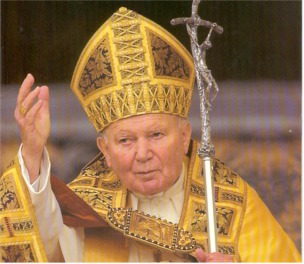
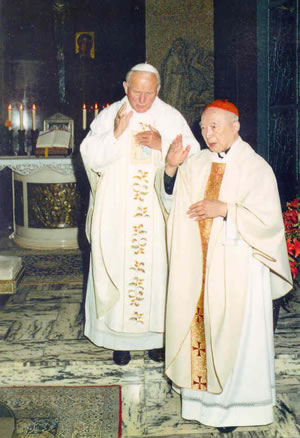
His Holiness Pope John Paul II praying inside the Basilica of St. Mary of the Angels in Assisi which now houses the Portiuncula. The photos below and inset show what the Chapel might have looked like during the time of St. Francis, nestled in the woods.

Guido, Bishop of Assisi, who was then in Rome, commended Francis to Cardinal John of St. Paul, and that at the instance of the latter, the pope recalled the saint whose first overtures he had, as it appears, somewhat rudely rejected. Moreover, in site of the sinister predictions of others in the Sacred College, who regarded the mode of life proposed by Francis as unsafe and impracticable, Pope Innocent, moved it is said by a dream in which he beheld the Poor Man of Assisi upholding the tottering Lateran, gave a verbal sanction to the rule submitted by Francis and granted the saint and his companions leave to preach repentance everywhere.


The dream of Pope Innocent showing St. Francis holding up the tottering Lateran Basilica, the Cathedral of Rome and the Mother and Head of all the Church in the City and in the World.

Before leaving Rome they all received the ecclesiastical tonsure, Francis himself being ordained deacon later on having felt unworthy to receive priestly ordination..

Monday, October 08, 2007

The Solemnity of St. Francis of Assisi

Why a Solemnity? Because, this year, I celebrated this feast at the Capuchin Friary of St. Felix of Cantalice. The Friary (because the Capuchins who are Franciscans of the 1st Order, are friars, not monks) house Friar Guardian Fr. Paul Cheong, Fr. Joe Matthews, Bro Allan Fernandez, brother of our parish priest, and Bro. Gilbert who's on his way to taking his vows. Oh, err... OFM Cap's all. They had celebrated the Transitus or Passing of St. Francis the day before, Oct 3rd.

DSC06869

Here's what the Friary Chapel looks like. It's a small Chapel, but sufficient for the needs of the friars who live there.

Among those who joined in the celebration were the extended Franciscan family in Penang, including the Franciscan Missionaries of the Divine Motherhood (FMDM) who have their convent here and operate the Mt. Miriam Cancer Hospital, the top such centre in the Northern Region of Malaysia, and the secular Franciscans.

DSC06871

Sr. Auxilia, FMDM read an introduction to the life of Sr. Francis before the Mass began.

DSC06873

The Mass was presided by Fr. Joe Matthews OFM Cap. Also concelebrating were Fr. Paul Cheong, OFM Cap. and Fr. Decroix MEP who lives across the street from the Friary. Note the nice Francis and Clare chasuble...

DSC06875

One of the Secular Franciscans read the First Reading, from the Book of Sirach about how Simon son of Onias rebuilt the house and fortified the Temple, things that are certainly applicable to the Poverello.

DSC06876

Bro. Gilbert then read the Psalm.

DSC06877

An FMDM sister read out the 2nd Reading as well the the Sequence for the Feast.

DSC06878

DSC06879

Fr. Joe delivered an excellent homily about the life and person of St. Francis of Assisi and how he preached the Gospel.

God's
Only
Son
Proclaiming
Eternal
Life


DSC06880

The music of the Mass were perennial Franciscan favourites such as the Canticle of the Sun and the Prayer of St. Francis.

DSC06881

I took this photo as the people were lining up for Communion. There were another 30 people in the adjoining hall of the friary as the Chapel could not contain them all.

DSC06882

The sister at the bottom right of the photo celebrated her Golden Jubilee in the Religious Life this year.

After the Mass, all adjourned outside for a feast, in typical Malaysian fashion. Unfortunately for you guys reading this, the camera batteries ran out, so you 'll just have to trust me when I tell you that the chicken curry, roast lamb, stuffed egg omelettes and other delicacies were delicious =) Like I told the Fr. Guardian, I was glad the did not serve St. Francis' favourite food... bread and water .. haha.

DSC06884

Anyway, I leave you with pamphlets distributed by the Secular Franciscans attempting to introduce their charism.

DSC06883

Friday, October 05, 2007

The Seraphic Father

By all accounts, St. Francis of Assisi, the Poverello or Poor Man of God was a remarkable person, whose single brief life of 45 years had done so much to alter the course of history for so many others who were inspired to imitate him as he imitated Christ and who in turn, like ripples in a pond, touched the lives of others. Many myths have surrounded this man who lived 800 years ago and like his Master, many have sought to mould him into their own image. Slightly kooky pacifist, ecologist extraordinaire, hippie of the Dark Ages, ecumenist, would be Green Peace activist. These are among the labels that the modern hip PC crowd have tried to foist on his, extolling him as their patron saint and spiritual progenitor. However, as we shall see, nothing can be further from the truth.

Who then is the man known now as the Seraphic Father? How is he relevant to Christians today? In 1993, the Editorial Staff of Time Magazine named him as one of the ten most influential people of the millennium, in the company of such luminaries as Gutenberg, who had invented the printing press, Mozart, Michelangelo, Shakespeare and Einstein. Among those who call themselves Franciscans include St. Anthony of Padua, St. Bonaventure, John Duns Scotus, Roger Bacon, François Rabelais, Alexander of Hales, William of Ockham, Giovanni da Pian del Carpini and in our own day, St. Pio of Pietrelcina, Mother Angelica, Fr. Benedict Groeschel, Archbishop Charles Chaput of Denver and Sean Cardinal O'Malley of Boston and Fr. Mychal F. Judge, the priest and fire chaplain who lost his life ministering to the fire fighters on 9/11 [and not to forger closet Franciscan Fr. Daren =)].

The Basilica of Our Lady of the Angels, housing the Portiuncula, in Assisi

What is it about this man that till today, attracts so many people to a life of radical abandonment to God? His spiritual progeny includes the ancient orders of the Friars Minor, the Capuchins and the Conventuals or the First Order, the Poor Clares of the Second Order and the Third Order priests and brothers. The Capuchins alone number about 11,000 now. Many newer orders, based on the Franciscan Rule and Spirituality also thrive such as Fr. Groeschel's Franciscan Friars of the Renewal and Mother Angelica's Poor Clares of Perpetual Adoration. There are 132 canonized Franciscan saints(That's a lot) and 242 Blesseds. According to the available statistics (1986), there are 36,117 members of the Franciscan Order in total. What motivates these people, these men and women to persist in the Franciscan way of life?

We'll explore this in a series of posts on the Poverello. Today, we look at his early life and his call to follow Christ.

According to his biographers, no one loved pleasure more than Francis; he had a ready wit, sang merrily, delighted in fine clothes and showy display. Handsome, cheerful, gallant, and courteous, he soon became the prime favourite among the young nobles of Assisi, the foremost in every feat of arms, the leader of the civil revels, the very king of frolic. But even at this time Francis showed an instinctive sympathy with the poor, and though he spent money lavishly, it still flowed in such channels as to attest a princely magnanimity of spirit.

A work by Giotto inside the Basilica of Assisi showing St. Francis giving away his coat.

One day, while crossing the Umbrian plain on horseback, out having fun with his friends when a beggar came along and asked for alms. The sudden appearance of this repulsive object filled him with disgust and he instinctively retreated. While his friends ignored the beggar's cries, Francis, presently controlling his natural aversion, dismounted, embraced the unfortunate man, and gave him all the money he had. His friends quickly chided and mocked him for his act of charity, and when he got home, his father scolded him in a rage. About the same time Francis made a pilgrimage to Rome. Pained at the miserly offerings he saw at the tomb of St. Peter, he emptied his purse thereon. Then, as if to put his fastidious nature to the test, he exchanged clothes with a tattered mendicant and stood for the rest of the day fasting among the horde of beggars at the door of the basilica.
The Crucifix of San Damiano speaking to St. Francis. The crucifix can be more clearly seen below.

Not long after his return to Assisi, whilst Francis was praying before an ancient crucifix in the forsaken wayside chapel of St. Damian's below the town, he heard a voice saying: "Go, Francis, and repair my house, which as you see is falling into ruin."

Yesterday's reading for the Feast of St. Francis, from the book of Sirach, perhaps foreshadowing the deeds of St. Francis himself, has this to say:

The leader of his brethren and the pride of his people ... who in his life repaired the house, and in his time fortified the temple.
He considered how to save his people from ruin, and fortified the city to withstand a seige.
Like the morning star among the clouds, like the moon when it is full; like the sun shining upon the temple of the Most High, and like the rainbow gleaming in glorious clouds;

Taking this behest literally, as referring to the ruinous church wherein he knelt, Francis went to his father's shop, impulsively bundled together a load of coloured drapery and sold both horse and stuff to procure the money needful for the restoration of St. Damian's.

What the Chapel might have looked like when St. Francis went to pray. Minus the table altar of course.

The elder Bernardone, a most niggardly man, was incensed beyond measure at his son's conduct, and Francis, to avert his father's wrath, hid himself in a cave near St. Damian's for a whole month. When he emerged from this place of concealment and returned to the town, emaciated with hunger and squalid with dirt, Francis was followed by a hooting rabble, pelted with mud and stones, and otherwise mocked as a madman. Finally, he was dragged home by his father, beaten, bound, and locked in a dark closet.

Was this then the end of Francis' fledgling vocation as a follower of Christ?

From various sources.

Wednesday, October 03, 2007

October, Month of the Holy Rosary

October is the month dedicated to the Most Holy Rosary and also the month when we commemorate the conclusion of the Apparitions at Fatima and the Miracle of the Sun. This year, were celebrate the 90th anniversary of Our Lady’s apparition.

I remember that when I was a kid, we would gather in front of our family altar every evening after dinner during the months of May and October to pray the rosary. Those sessions in prayer have left a very deep impression on me till this day and I remember them as vividly as if it were only yesterday. My grandparents thought me all the prayers, the Aves and Paters and Glorias when I was very young and so assumed that I knew how to pray. But somehow, during the prayer, I would always finish faster than anyone else, even when I tired praying slower. They always wondered about it… but I did assure them I COULD count to ten! Then one day, we figured out what was wrong. Instead saying one Hail Mary for of every bead, I said the Hail Mary on one bead and moved on to the next bead for the Holy Mary, Mother of God =)

My grandmother has a very strong devotion of Mary and prays the Holy Rosary daily, even to this day. She stills carries it around with her wherever she goes and is always in her pocket. My late grandfather too, prayed the Holy Rosary regularly and one of the earliest gifts I received from them is a rosary. Some of my most prized possessions are my grandfather’s rosaries, which I hope to highlight in the upcoming days. The communal praying of the Holy Rosary before the Novena on Saturday which I am privileged to lead once a month is one of the highlights which I always look forward to.

After the Second Vatican Council, the practice of praying the Holy Rosary, the Novenas and other personal devotions such as Adoration of the Blessed Sacrament (the Eucharist if for eating, not for looking at!) fell by the wayside as many Catholics thought of themselves as too sophisticated to pray these relics of a bygone age. In my own parish Church, when I was younger, I do not remember the communal recitation of the Rosary nor Adoration or Benediction. This is, of course, like many other things such as the use of Latin in the liturgy and the pride of place occupied by Gregorian Chant, is totally opposed to the Letter and Authentic Spirit of Vatican II. But those Western ‘experts’ (who mostly later left the priesthood and married former nuns after wreaking havoc on the Church and wrecking many beautiful Temples to God’s glory) sure taught many of the local ‘missionary’ Churches better and foisted the very modernism that would incapacitate and cripple their own Churches in due course.

But now, thanks to the teaching and personal example of His Holiness Pope John Paul II and Pope Benedict XVI as well, these devotions, stemming from a childlike faith and confidence in God and in His saints has come back to the fore and is now mainstream and those who pray the Holy Rosary are no longer freaks of a bygone era. Pope John Paul II himself could always be seen in prayer and the rosary is always in his hand whenever he has a spare moment, whether on a place or in a meeting with the Youth. Pope Benedict XVI prays the rosary in the walks he takes in the mountains during his vacations.

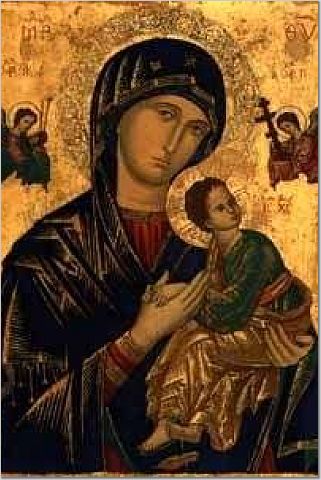
In the months of October, in my own parish, the Holy Rosary is recited before the principal weekend Masses, led by the various ministries and cell groups within the Church. During the weekday Masses, the Holy Rosary is recited after the morning Masses and before the Evening Masses. On every 13th day of the month, a special Mass is held after the praying of the Holy Rosary at the outdoor altar before Our Lady’s Grotto. The Novena to Our Lady of Perpetual Help is prayed after the Holy Rosary every Saturday evening followed by Benediction with the Blessed Sacrament.

The Rosary is back for good and those with the most fervent devotion to Our Lady are often the very same people with the most devotion to Our Lord. This should not surprise us as Mary ever points us towards Christ, her Son and her Lord as the Morning Star points us towards the coming of the Dawn and the Rising of Sun.

Let us then, in this month of the Rosary, pray most fervently for the intercession of Our Lady before her Son and Lord.

Tuesday, October 02, 2007

Pope: Bishops should be like angels

On Saturday, the Feast of the Holy Archangels Michael, Gabriel and Raphael which in the extraordinary calendar is the Feast of St. Michael or Michaelmas, Pope Benedict consecrated 6 men to the episcopate, transmitting to them the fullness of the priesthood. These are his first episcopal ordinations since his own election as Pope so I thought I'd share it with you.

And the vestments used by the Holy Father were pretty decent too.

From Zenit.

Bishops Should Be Like the Angels, Says Pope

Ordains 5 Italians and 1 Pole to Episcopacy


CASTEL GANDOLFO, Italy, SEPT. 30, 2007 (Zenit.org).- Bishops must be "angels" for others, explained Benedict XVI on Saturday, during the ordination Mass for six more successors to the apostles.


In a crowded St. Peter’s Basilica, the Pope performed his first episcopal ordinations since his election to the See of Peter.

He ordained five Italians and one Pole.


Noting the liturgical feast of the archangels, the Holy Father told the new prelates that in the early Church, bishops were considered to be like angels, because their service recalls that offered by the celestial creatures.

The life, focus and mission of all bishops must of course be Christ Himself

"They are God’s messengers. They bring God to man, they open heaven and earth," the Pope said. "Because they are near God, they can also be very close to man. God, in fact, is nearer to us than we are to ourselves.

"Angels speak to man about what his true being is, about what is very often covered and buried in his life. They call to him to go within himself."


During the chanting of the Litany of the Saints, all kneel as those to be consecrated bishops prostrate themselves in a sign of humility and total surrender.


The Holy Father affirmed that bishops, in particular, "must be men of God, must live a life oriented toward God."


"The bishop," he said, "must be a man of prayer, one who intercedes to God for men. The more he does this, the more he understands those entrusted to him and can become an angel for them -- God’s messenger, who helps them to find their true nature […] and to live the idea that God has of them."
The transmission of Apostolic Succession, the Laying of Hands. The Pope lays his hands on those to be consecrated bishops, transmitting to them the succession which each bishop can trace, all the way back to the Apostles, the sign and symbol of the preservation of the Catholic and Apostolic Faith, once for all delivered to the Saints and the transmission of the fullness of the Christian ministerial priesthood.

All bishops present also lay hands of those to be newly consecrated.


Bernard Cardinal Law, Archbishop Emeritus of Boston laying hands on Bishop Sergio Pagano

Benedict XVI ordained Monsignor Mieczyslaw Mokrzycki, his assistant secretary who had the same role for Pope John Paul II. Archbishop Mokrzycki, 46, is coadjutor of the Latin-rite Archdiocese of Lviv, in Ukraine.

Pope Benedict XVI the mitre on Monsignor Mieczlsaw Mokrzycky's head.

The other newly-ordained prelates are Archbishop Gianfranco Ravasi, 64, new president of the Pontifical Council for Culture; Archbishop Tommaso Caputo, 56, apostolic nuncio to Malta and Libya; Archbishop Francesco Brugnaro, 64, of the Archdiocese of Camerino-San Severino Marche, Italy; Bishop Sergio Pagano, 58, new prefect of the Vatican Secret Archives; and Bishop Vincenzo di Mauro, 55, secretary of the Prefecture for the Economic Affairs of the Holy See.

Cardinal Tarcisio Bertone, the Pope's secretary of state, and Cardinal Marian Jaworski, the 81-year-old Latin-rite archbishop of Lviv, co-consecrated the new bishops.

Monday, October 01, 2007

Out Marini, in Marini

Rumours confirmed.

VATICAN CITY, OCT 1, 2007 (VIS) - The Holy Father:

- Appointed Archbishop Piero Marini, master of Papal Liturgical Celebrations, as president of the Pontifical Committee for International Eucharistic Congresses.

- Appointed Fr. Guido Marini of the clergy of the archdiocese of Genoa, Italy, as master of Papal Liturgical Celebrations.


Want to find out more? Well, email him! guidomarini@inwind.it

Or perhaps send him a message, courtesy of the Archdiocese of Genoa.


scrivi un messaggio


We hope for a marked improvement of the aesthetics of Papal Liturgical Ceremonies and a return to a more traditional celebration of the liturgy. And better vestments!

Feast of the Exaltation of the Holy Cross

Malacca was colonized by the Portuguese in 1511 and the Catholic Faith by brought to these shores by illustrious missionaries such as St. Francis Xavier who had used Malacca as a base for his missionary endeavours to China and Japan.

There's a Chapel dedicated to the Holy Cross in Malim Hill which has been a pilgrimage site because of the graces that have been obtained by those who had devoutly prayed there and Santa Cruz is a major Feast for those in Malacca, second only to St. Peter's and Holy Week in drawing the crowds.

Here's an account from the local newspaper of how this Feast was celebrated this year.

MALACCA: Without fail, Hong Kong’s Jacob Ng Wey has been making it a point to attend the prayers to commemorate the Feast of the Holy Cross (Santa Cruz) in Malacca for the past eight years.

The 48-year-old who is based in Singapore said he had found a sense of peace since joining several of his Catholic working colleagues on a pilgrimage to Malim Hill in 2000.

Act of devotion: A devotee lighting a candle during the night vigil preceding the feast celebrations.
“I hold a great reverence to this feast. Somehow, since the visit, I have managed to overcome many personal difficulties and this has given me a refreshing sense of peace and life’s tranquility,” remarked Jacob, a shipbuilding senior technologist at Sembawang.

He joined thousands of pilgrims and devotees both Catholics as well as non-Christians from all over Malaysia and Singapore to commemorate the Feast of Santa Cruz or Holy Cross observed annually on the second Sunday in September.

Housewife Lynette Lai of Kota Kinabalu who was baptised a Catholic, said the origins of the feast is unclear and shrouded with uncertainties

“It is the belief by so many that inspires me to seek special blessings and grace of the Holy Cross, she said.

Aloysius Arokiasamy of Klang who is making his 12th consecutive pilgrimage here concurred with Lynette’s views.

He said that devotion to the Holy Cross had brought spiritual and material relief to many.

The quaint Chapel of Santa Cruz on top of Malim Hill along the old Malacca-Alor Gajah trunk road has been surrounded for generations by an intriguing mix of mystery, legends and faithful devotion.

Despite the chapel’s origin laced with nothing concrete, the Feast of Santa Cruz continues to draw more Catholic pilgrims and non-Christian devotees.

Located between an old rubber estate and an ancient Chinese graveyard, the chapel, which comes under the jurisdiction of Malacca’s St. Peter’s Church, is open only once a year during the commemoration of the feast and has been a place of Catholic homage for over 150 years.

Morning prayers: Rev Fr Moses Lui of St Peter's Church presiding at the early morning religious service at the Feast of the Holy Cross in Malacca recently.
Historically, there is little to substantiate the basis for the beliefs and devotions surrounding the chapel but a small wooden chapel was built between 1870 and 1880 following the discovery of a cross in the vicinity. The then wooden edifice was eventually replaced by the present brick building.

Indeed, tracing the origins of the Feast of Santa Cruz proves an interesting exercise with varied versions from sources lending still more mystique.

Several accounts tell the tale of a certain devout Catholic lady from Kubu in Malacca who had fallen ill and all possible medical aid was given to her but to no avail.

Then, one night in her dreams, an old man appeared and told her that a cross would be found at the top of Malim Hill.

A couple of days later with the assistance of several neighbours, the women’s family found a 46cm high wooden cross on the hill, partially covered by a termites’ nest.

Still another version attributes the finding of a wooden cross to one of the children of Joanna Sta Maria of the Portuguese community residing in Tengkera.

The child supposedly dreamt for three consecutive nights about a small cross that should be sought after at Malim Hill.

Others are more prosaic when discussing the origins of the feast.

According to the book Survival Through Human Values authored by the late Fr Manuel Pintado a former parish priest of St Peter’s, Malacca was a Christian town from 1511 to 1641 with a church or chapel along every street and atop hills.

The cross could well have been a grave marker or affixed to a place of worship which subsequently went into ruin during the 154-year Dutch occupation of Malacca where the practice of the Catholic faith was not permitted, said Fr. Pintado

Whatever the origins of the cross may be, the Feast of Santa Cruz will continue to draw large numbers of pilgrims and devotees to Malacca yearly in September.