Wednesday, October 05, 2011

Eucharistic miracle in Poland

Whenever there are Eucharistic miracles, such as the one in Lanciano, it has been in response to some doubt or lack of faith in the Real Presence of Christ in the Eucharist.

This is also a lesson for all priests and those handling the Host to be most attentive and careful of the precious treasure they are holding in their consecrated hands!

Are we guilty, in our actions and in the way we behave before the Blessed Sacrament or in the manner we receive? Let us be more attentive to this greatest of the treasures of the Church, the Body and Blood, Soul and Divinity of Our Lord Jesus Christ and approach Him with all reverence and adoration.

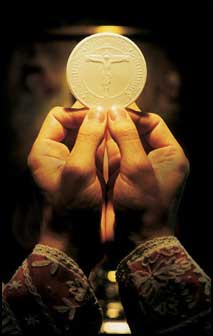
Roman Catholics in Poland gathered Sunday for a special Mass celebrating what they see as a miracle: the appearance on a communion wafer of a dark spot that they are convinced is part of the heart of Jesus.

The communion wafer in question developed a brown spot in 2008 after falling on the floor during a Mass in the eastern Polish town of Sokolka. Two medical doctors determined that the spot was heart muscle tissue, church officials have said.

Bialystok Archbishop Edward Ozorowski said during the Mass that in history, the "substance of Christ's body or blood has become available to the human senses, and this also happened in Sokolka."

"For God, nothing is impossible," Ozorowski said.
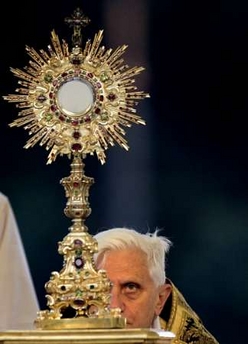
The dark-spotted wafer was carried aloft in a reliquary by a golden-robed priest in a procession and was put on display in the town's church of St. Anthony as about 1,000 faithful looked on, according to a report and footage carried by the TV station TVN.

Catholics believe that the bread and wine that priests use during the sacrament of communion - or the Eucharist - are changed into the body and blood of Jesus Christ.

The nun's discovery sparked huge interest among the faithful in this deeply Roman Catholic country, sparking large numbers to flock to Sokolka. Though some believers consider the object miraculous, the Vatican is still examining the matter and has not yet officially decided whether to declare it a miracle, church spokesman Andrzej Debski said.


A group of rationalists complained about the matter in 2008, and called on authorities to investigate if a murder or other crime was involved if human flesh was indeed found on the wafer. Police say they have no evidence of any crime.

Tuesday, October 04, 2011

Brilliant quote from Blessed Pope John Paul the Great


Freedom consists not in doing what we like, but in having the right to do what we ought.
-Pope John Paul II : Homily in Orioles Park at Camden Yards - 8 October 1995

Monday, October 03, 2011

This I swear


I've signed the Oath Against Modernism. Have you?

THE OATH AGAINST MODERNISM
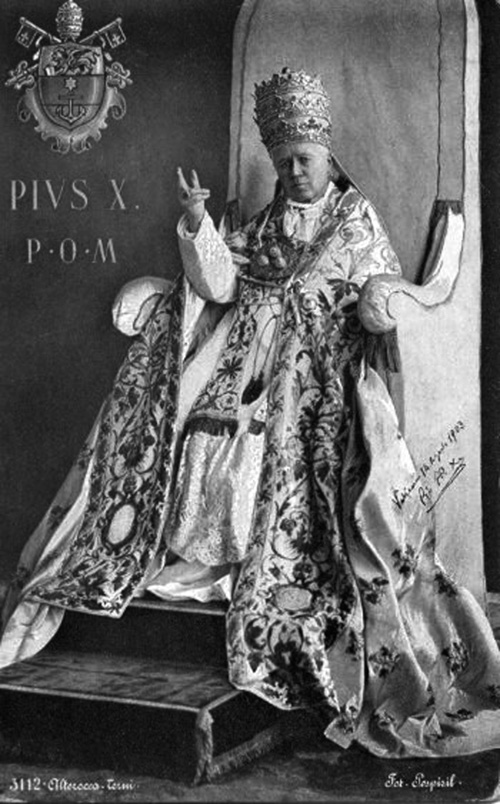
Given by His Holiness St. Pius X September 1, 1910.

To be sworn to by all clergy, pastors, confessors, preachers, religious superiors, and professors in philosophical-theological seminaries.
I Andrew Khoo, firmly embrace and accept each and every definition that has been set forth and declared by the unerring teaching authority of the Church, especially those principal truths which are directly opposed to the errors of this day. And first of all, I profess that God, the origin and end of all things, can be known with certainty by the natural light of reason from the created world (see Rom. 1:90), that is, from the visible works of creation, as a cause from its effects, and that, therefore, his existence can also be demonstrated:


Secondly, I accept and acknowledge the external proofs of revelation, that is, divine acts and especially miracles and prophecies as the surest signs of the divine origin of the Christian religion and I hold that these same proofs are well adapted to the understanding of all eras and all men, even of this time.


Thirdly, I believe with equally firm faith that the Church, the guardian and teacher of the revealed word, was personally instituted by the real and historical Christ when he lived among us, and that the Church was built upon Peter, the prince of the apostolic hierarchy, and his successors for the duration of time.

Fourthly, I sincerely hold that the doctrine of faith was handed down to us from the apostles through the orthodox Fathers in exactly the same meaning and always in the same purport.

Therefore, I entirely reject the heretical' misrepresentation that dogmas evolve and change from one meaning to another different from the one which the Church held previously. I also condemn every error according to which, in place of the divine deposit which has been given to the spouse of Christ to be carefully guarded by her, there is put a philosophical figment or product of a human conscience that has gradually been developed by human effort and will continue to develop indefinitely.

Fifthly, I hold with certainty and sincerely confess that faith is not a blind sentiment of religion welling up from the depths of the subconscious under the impulse of the heart and the motion of a will trained to morality; but faith is a genuine assent of the intellect to truth received by hearing from an external source. By this assent, because of the authority of the supremely truthful God, we believe to be true that which has been revealed and attested to by a personal God, our creator and lord.

Furthermore, with due reverence, I submit and adhere with my whole heart to the condemnations, declarations, and all the prescripts contained in the encyclical Pascendi and in the decree Lamentabili, especially those concerning what is known as the history of dogmas. I also reject the error of those who say that the faith held by the Church can contradict history, and that Catholic dogmas, in the sense in which they are now understood, are irreconcilable with a more realistic view of the origins of the Christian religion. I also condemn and reject the opinion of those who say that a well-educated Christian assumes a dual personality-that of a believer and at the same time of a historian, as if it were permissible for a historian to hold things that contradict the faith of the believer, or to establish premises which, provided there be no direct denial of dogmas, would lead to the conclusion that dogmas are either false or doubtful.

Likewise, I reject that method of judging and interpreting Sacred Scripture which, departing from the tradition of the Church, the analogy of faith, and the norms of the Apostolic See, embraces the misrepresentations of the rationalists and with no prudence or restraint adopts textual criticism as the one and supreme norm. Furthermore, I reject the opinion of those who hold that a professor lecturing or writing on a historico-theological subject should first put aside any preconceived opinion about the supernatural origin of Catholic tradition or about the divine promise of help to preserve all revealed truth forever; and that they should then interpret the writings of each of the Fathers solely by scientific principles, excluding all sacred authority, and with the same liberty of judgment that is common in the investigation of all ordinary historical documents.

Finally, I declare that I am completely opposed to the error of the modernists who hold that there is nothing divine in sacred tradition; or what is far worse, say that there is, but in a pantheistic sense, with the result that there would remain nothing but this plain simple fact-one to be put on a par with the ordinary facts of history-the fact, namely, that a group of men by their own labor, skill, and talent have continued through subsequent ages a school begun by Christ and his apostles.

I firmly hold, then, and shall hold to my dying breath the belief of the Fathers in the charism of truth, which certainly is, was, and always will be in the succession of the episcopacy from the apostles. The purpose of this is, then, not that dogma may be tailored according to what seems better and more suited to the culture of each age; rather, that the absolute and immutable truth preached by the apostles from the beginning may never be believed to be different, may never be understood in any other way.

I promise that I shall keep all these articles faithfully, entirely, and sincerely, and guard them inviolate, in no way deviating from them in teaching or in any way in word or in writing. Thus I promise, this I swear, so help me God.

I think many bishops, priests and professors who took this oath have perjured themselves in the revolution that occurred after Vatican II and may God be their judge, for the damage their collective action, and inaction, their abdication of their duty and their sacred trust have caused God's Holy Catholic Church.

Thursday, September 29, 2011

Tuesday, September 27, 2011

Pass the aspirin please

Pondering stuff makes my head hurt, but sometimes, I do try to brave the pain and ponder anyway. It's sadistic, I know, buy hey...

I'm a catechist. I teach students the Catholic Faith as I promised to do, in a public profession of faith during Mass one fine day some time ago. Unfortunately, I take my vows to God seriously. So I try my best. I do enjoy teaching the Catholic faith, sharing it's great beauty and power, it's awesomeness in the fullest sense of the word. For many, it's the first time they have heard the faith articulated and presented without the caveats, the watering downs to cater to their level. It's one thing to have Divine Condescension but its another to constantly think of our young people as such blooming idiots with such sensitive minds that any objective truth claims such as the existence of God, the last Judgement and reality and permanence of Heaven and Hell and clear presentations of Catholic morality will drive them all away.

This should be the textbook we use (It's a really good book)

Ok, no more rants. It alleviates the pain in my head somewhat, but let's try to look at the situation objectively.

Kids these days are subjected to harrowing experiences in school. School is only bearable to them because of their friends. Most teachers don't take their job seriously and the haphazard and ill prepared classes bore the kids into the ground. That they're striving so hard to be Barney-like and preach not Christ Crucified but Buddy-Christ doesn't help either. (Nothing puts kids off so much as teachers trying their best to be groovy)


What the teacher wants to be

How the teacher sees himself (Groovy baby!)
How the class sees the teacher


The Jesus that is preached

Five days a week of mind-numbingly boring lessons, homework, tuition and even more homework, and come Sunday, they go into class rooms, sit in chairs in front of a teacher and a blackboard and the teacher starts to speak. Deja vu. Their eyes glaze over. Half the battle is lost. The Faith has become one more subject is a sea of others which the kids haven't the slightest interest in. That's the setting.

Now lets talk about the subject matter. I've always referred to catechism classes as a kind of inoculation. To innoculate someone against a disease, you vaccinate them by injecting a weak strain into their system and the body builds up anti-bodies and presto, when the real thing comes along, the body is immune and is able to fight off the disease. The weak strain of Catholicism, the watered down, milky and syrupy sweet pleasantries that are forced down their throats quickly immunize our young against true authentic and meaty Catholicism so that even when the real thing is taught, not only do we have to overcome the problem of the setting, we have to over power years of immunization and the internal resistance that has been built up and reinforced.


The substance of our teaching - watery gruel

On a good day, the gruel may be chunky (yummmm how appetizing), but it's still gruel

The meat of the Gospel

Is there any wonder then that our children are (for the most part, hopefully) theoretical theists but practical atheists? More on that some other time. I intend to muse some more on practical atheism, our duty as evangelists (it's GOOD NEWS!) and the failures and dangers of being a catechist. But, more on that later. I gotta go get some aspirin now. The pain of pondering is making me black out.

Monday, August 15, 2011

A patronal meme

Dear Fr Daren from Servant and Steward has kindly tagged me in a meme and since I've not blogged in a while, this is a great excuse to get started. Here's the meme, asking, if I should be canonized, of what would I be patron:

Assuming you are a saint, and your cause has been executed, your miracles confirmed, your date on the calendar established, all that is required is to select that of which Holy Mother Church will name you Patron(ess) of.

For this meme, you must name your patronage and then tag 5 other people who would like to play along.
Linking your answer to your nominator's post would make it easier to get
your answers.
This is a very interesting question. Not that I've spent huge amounts of time pondering my eventual canonization (*wink wink) but after having given it some (all of 5 seconds of) thought, I do believe that I've managed to decently scrape together a few things that I'd like to be patron of.

  1. Penang, Malaysia (and probably Singapore too since they're not likely to have a saint anytime soon unless the Papal Ninja's can pull something out of the hat)
  2. Tanjung Bunga, in Penang (hopefully the seedbed of many many more saints to come)
  3. Masters of Ceremonies (which I have to share with Fr. Daren);
  4. Marching bands
  5. Conductors (the music kind, not the bus or electrical kind)
I'd also like to be patron of the upcoming Crusades and the Reconquista (I'd have to cede the New Evangelization to John Paul the Great, but perhaps be Patron of the Old Evangelization? [the kind that worked?] and maybe be surnamed Matamoros and the Hammer of Heretics but let's not get too carried away.

PS
Does Facebook and Gmail have a patron saint? I'm (gonna be, anyway) open you know.

Monday, March 07, 2011

Staying sane in a mad mad world

Very often, in the course of our lives and especially in doing work within a Church context, we encounter people who are infuriating and appear to us as just plain dumb. The things that they do and say and the manner in which they seem to set themselves up as your personal opposition, to create stumbling blocks and carefully planting them in your path makes you wonder if they are the Devil's minions, seeking to frustrate the work of God which you're doing. You wonder to yourself, are they just plain stupid, blind, or just plain evil. Why can't they see the good that you are doing, why can't they, if they're not helping you, just leave you be, why can't they see that stupid things that they are doing and the stupid, outdated ways which they are doing it, why can't they see the wisdom our your way (aka the RIGHT WAY)? It's all just so frustrating you just want pop a blood vessel and die.

And this is where some of the best advice I'm been given helps me. I have to ask myself, are they doing what they do out of malice, or perhaps misinformation or even jealousy. Are they doing the best they can in the best way that they can see how to? Putting ourselves in another's shoes is a very important and very difficult virtue to practice. Sometimes, we just need to stop and to see things from the perspective of the other. And to refrain from attributing all opposition to malice and malfeasance. In short, we should not be too quick to judge. It's a tough lesson to learn and an even tougher virtue to practice (especially when the blighters continue their #$%^^@ ways day after day and week after week with no relief in sight barring the parousia.

But to survive with any measure of sanity or good humour in the world of voluntary work, especially in a Church environment, it's absolutely essential that this lesson be learnt and an attempt made to try to just step back and look at the bigger picture.